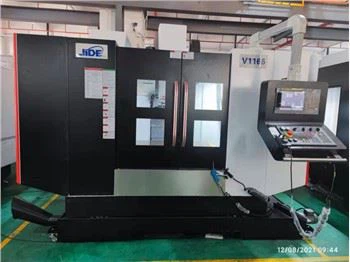
Hey there, fellow machining enthusiasts! As a supplier of Mini Cnc Mills, I've seen firsthand how the spindle power can make or break the performance of these nifty little machines. Today, I'm gonna dive deep into how spindle power affects the performance of a Mini Cnc Mill, and why it's a crucial factor to consider when you're in the market for one.
First off, let's talk about what the spindle is and what it does. The spindle is the heart of a CNC mill. It's the part that holds the cutting tool and rotates it at high speeds to remove material from the workpiece. The power of the spindle determines how much force it can apply to the cutting tool, which in turn affects how quickly and efficiently the machine can cut through different materials.
Material Removal Rate
One of the most significant ways spindle power affects the performance of a Mini Cnc Mill is through the material removal rate (MRR). The MRR is a measure of how much material the machine can remove in a given amount of time. A higher spindle power means the machine can apply more force to the cutting tool, allowing it to take deeper cuts and remove material at a faster rate.
For example, if you're working with a hard material like stainless steel, a Mini Cnc Mill with a low spindle power might struggle to make deep cuts without overheating the cutting tool or causing excessive wear. On the other hand, a mill with a higher spindle power can handle the tough material more easily, making it possible to achieve a higher MRR and complete your projects more quickly.
Cutting Speed and Feed Rate
Spindle power also plays a crucial role in determining the optimal cutting speed and feed rate for your machining operations. The cutting speed is the speed at which the cutting tool moves through the material, while the feed rate is the speed at which the workpiece is fed into the cutting tool.
A higher spindle power allows for a wider range of cutting speeds and feed rates. This means you can adjust these parameters to suit the specific requirements of your project, whether you're looking for a rough cut to quickly remove large amounts of material or a fine finish for a precision part.
For instance, when using a Vertical Machine, you might want to increase the cutting speed and feed rate when roughing out a part to save time. However, when finishing the part, you'll likely need to reduce these parameters to achieve a smooth surface finish. A Mini Cnc Mill with sufficient spindle power gives you the flexibility to make these adjustments without sacrificing performance.
Tool Life
Another important aspect affected by spindle power is tool life. When the spindle power is too low for the material and cutting conditions, the cutting tool has to work harder to remove material. This can lead to increased wear and tear on the tool, reducing its lifespan and increasing your tooling costs.
On the other hand, a Mini Cnc Mill with adequate spindle power can apply the right amount of force to the cutting tool, allowing it to cut through the material more efficiently and with less stress. This results in less wear on the tool and longer tool life, which can save you money in the long run.


Precision and Accuracy
Precision and accuracy are critical in CNC machining, and spindle power can have a significant impact on these factors. A spindle with insufficient power may experience fluctuations in speed and torque during cutting, which can cause vibrations and lead to inaccurate cuts.
A high-powered spindle, on the other hand, is more stable and can maintain a consistent speed and torque throughout the machining process. This helps to ensure that your cuts are precise and accurate, resulting in high-quality parts that meet your specifications.
For example, if you're using a Vertical Milling Machine Axis to machine a complex part with tight tolerances, a stable and powerful spindle is essential to achieve the required precision.
Surface Finish
The surface finish of the machined part is another area where spindle power can make a difference. A higher spindle power allows for smoother and more consistent cuts, which can result in a better surface finish.
When the spindle power is too low, the cutting tool may not be able to cut through the material cleanly, leaving behind rough edges or surface imperfections. With sufficient spindle power, the cutting tool can remove material smoothly and evenly, producing a part with a high-quality surface finish.
Choosing the Right Spindle Power
So, how do you choose the right spindle power for your Mini Cnc Mill? Well, it depends on several factors, including the types of materials you'll be working with, the size and complexity of your projects, and your desired production rates.
If you'll be primarily working with soft materials like aluminum or wood, a lower spindle power may be sufficient. However, if you plan to work with harder materials like steel or titanium, or if you need to achieve high production rates, you'll likely need a mill with a higher spindle power.
For most general-purpose machining applications, a Mini Cnc Mill with a spindle power of around 1 - 3 horsepower (HP) is a good starting point. However, if you have more demanding requirements, such as high-speed machining or heavy-duty cutting, you may want to consider a mill with a spindle power of 5 HP or more.
For example, our Precision Cnc Milling Machine 850 offers a range of spindle power options to suit different needs. Whether you're a hobbyist looking for a versatile machine for small projects or a professional machinist in need of a high-performance mill for large-scale production, we've got you covered.
Conclusion
In conclusion, the spindle power of a Mini Cnc Mill has a profound impact on its performance. It affects the material removal rate, cutting speed and feed rate, tool life, precision and accuracy, and surface finish. By choosing the right spindle power for your specific needs, you can ensure that your Mini Cnc Mill operates at its best and helps you achieve your machining goals.
If you're in the market for a Mini Cnc Mill and have any questions about spindle power or any other aspect of our machines, don't hesitate to reach out. We're here to help you find the perfect machine for your needs and ensure that you get the most out of your investment. Let's start a conversation and see how we can work together to take your machining projects to the next level!
References
- "CNC Machining Handbook" by Peter Zelinski
- "Modern Machining Technology" by Robert L. Nowakowski