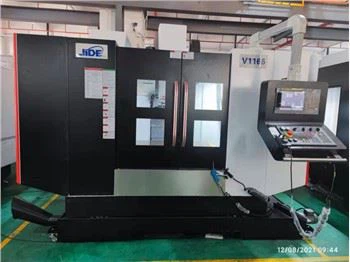
The automatic tool changer (ATC) is a crucial component in a heavy-duty CNC vertical milling machine, significantly enhancing its efficiency, flexibility, and overall performance. As a leading supplier of heavy-duty CNC vertical milling machines, we understand the importance of this feature and its impact on various manufacturing processes.
1. Enhancing Productivity
One of the primary functions of the ATC is to boost productivity. In traditional milling operations, changing tools manually is a time - consuming process. Operators need to stop the machine, remove the current tool, and install a new one, which can take several minutes depending on the complexity of the tool and the machine setup. This downtime accumulates over multiple tool changes during a machining job, reducing the overall production rate.
With an automatic tool changer, the process is streamlined. The ATC can select and change tools in a matter of seconds. For example, in a complex machining process that requires multiple types of end mills, drills, and taps, the ATC can quickly switch between these tools without any manual intervention. This means that the machine can operate continuously for longer periods, maximizing the amount of work completed in a given time frame. As a result, manufacturers can increase their output, meet tight production schedules, and take on more orders.
2. Improving Precision
Precision is a critical aspect of machining, especially in industries such as aerospace, automotive, and medical device manufacturing. Manual tool changes can introduce errors due to human factors. For instance, improper tool installation can lead to incorrect tool offsets, which in turn can cause dimensional inaccuracies in the machined parts.
The ATC in a heavy - duty CNC vertical milling machine ensures consistent and accurate tool changes. The tools are stored in a tool magazine in a pre - defined position, and the ATC is programmed to pick and place the tools with high precision. This eliminates the variability associated with manual tool changes, resulting in more accurate and repeatable machining operations. The machine can maintain tight tolerances throughout the production run, ensuring that each part meets the required specifications.
3. Increasing Flexibility
Heavy - duty CNC vertical milling machines with ATCs offer greater flexibility in machining operations. They can handle a wide variety of machining tasks without the need for extensive retooling. For example, a single machine can perform milling, drilling, boring, and tapping operations by simply changing the tools in the ATC. This allows manufacturers to produce a diverse range of parts on the same machine, reducing the need for multiple specialized machines and saving on capital investment.
Moreover, the ATC enables quick adaptation to design changes. If a part design requires a different set of tools, the machine can be reprogrammed to use the new tools from the tool magazine. This flexibility is particularly beneficial in industries where product designs are constantly evolving, such as the consumer electronics industry.
4. Reducing Labor Costs
Manual tool changing requires skilled operators to perform the task accurately and efficiently. These operators need to be trained in tool handling, installation, and alignment, which can be time - consuming and expensive. Additionally, the labor - intensive nature of manual tool changes means that more operators may be required to keep the production line running smoothly.
By automating the tool - changing process with an ATC, the need for manual labor in tool changes is eliminated. This reduces labor costs and allows operators to focus on other tasks, such as monitoring the machining process, inspecting parts, and programming the machine. As a result, manufacturers can achieve cost savings while maintaining or improving productivity.
5. Enabling Unattended Operation
The ATC makes it possible for heavy - duty CNC vertical milling machines to operate unattended for extended periods. Once the machine is programmed with the appropriate tool paths and the tool magazine is loaded with the necessary tools, the ATC can automatically change tools as required during the machining process. This is particularly useful for overnight or weekend production runs, where the machine can continue to work without human supervision.
Unattended operation not only increases productivity but also reduces the risk of human error. Since there is no need for operators to be present during tool changes, the chances of mistakes due to fatigue or distraction are minimized. However, it is important to note that proper monitoring systems should be in place to detect any potential issues, such as tool breakage or machine malfunctions.
Related Products
If you are interested in exploring more CNC milling machine options, we offer a variety of products, including the Desktop Cnc Metal Milling Machine and the Benchtop 3 Axis Cnc Milling Machine. These machines are designed to meet different production needs and budgets. Additionally, you can check our CNC Machine Price for Sale page to find the most cost - effective solutions for your manufacturing requirements.
Conclusion
In conclusion, the automatic tool changer in a heavy - duty CNC vertical milling machine plays a vital role in modern manufacturing. It enhances productivity, improves precision, increases flexibility, reduces labor costs, and enables unattended operation. By investing in a machine with an ATC, manufacturers can gain a competitive edge in the market by producing high - quality parts more efficiently and cost - effectively.


If you are considering purchasing a heavy - duty CNC vertical milling machine or need more information about the ATC and its benefits, we encourage you to contact us for a detailed discussion. Our team of experts is ready to assist you in finding the right solution for your specific machining needs.
References
- Groover, M. P. (2010). Fundamentals of Modern Manufacturing: Materials, Processes, and Systems. Wiley.
- Dornfeld, D. A., Min, S., & Takeuchi, Y. (2006). Handbook of Machining with Grinding Wheels. CRC Press.