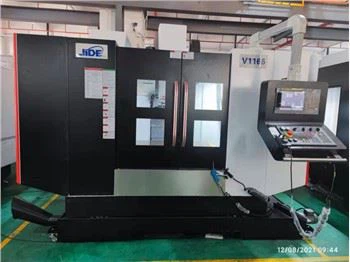
Hey there! As a supplier of CNC milling machines, I often get asked about the main components of these amazing pieces of equipment. So, I thought I'd take a few minutes to break it down for you.
The Bed
Let's start with the bed. It's like the foundation of a house for the CNC milling machine. The bed provides a stable base for all the other components. It needs to be super sturdy because it has to support the weight of the entire machine and withstand the forces generated during the milling process. A well - built bed ensures that the machine operates smoothly and accurately. Without a solid bed, the machine could vibrate excessively, leading to poor quality cuts and reduced precision.
The Column
Next up is the column. The column is attached to the bed and stands upright. It's where a lot of the vertical movement happens. Think of it as the backbone that holds up the spindle head and other important parts. The column houses the mechanisms that allow the spindle head to move up and down. This vertical movement is crucial for creating different depths in the workpiece. It's also designed to be rigid to maintain the accuracy of the milling operations.


The Spindle
Now, the spindle is one of the most critical components. It's like the heart of the CNC milling machine. The spindle holds the cutting tool and rotates it at high speeds. Different types of cutting tools can be mounted on the spindle depending on the specific milling task. For example, end mills, ball nose mills, and drill bits can all be used. The spindle's speed can be adjusted according to the material being milled and the type of operation. High - speed spindles are great for finishing cuts, while lower speeds are often used for roughing operations.
The Table
The table is where the workpiece is placed. It can move in different directions, usually in the X and Y axes. This movement allows the cutting tool to access different areas of the workpiece. The table is designed to hold the workpiece securely in place. Some tables have T - slots where clamps can be used to fasten the workpiece. Others may use vacuum chucks for better holding power, especially for thin or delicate materials. The smooth movement of the table is essential for accurate milling.
The Controller
The controller is the brain of the CNC milling machine. It reads the program that contains the instructions for the milling operation. This program tells the machine where to move the table, how fast to rotate the spindle, and when to engage the cutting tool. Modern controllers are very sophisticated and can handle complex milling operations. They often have a user - friendly interface that allows operators to input and modify programs easily. Some controllers even have built - in diagnostic features to help troubleshoot problems.
The Drive System
The drive system is responsible for moving the table and the spindle. There are usually servo motors or stepper motors used in the drive system. Servo motors are more precise and can provide better control over the movement. They can adjust their speed and position based on the feedback from sensors. Stepper motors, on the other hand, are less expensive but may not offer the same level of precision. The drive system also includes ball screws or linear guides that convert the rotational motion of the motors into linear motion for the table and spindle.
The Coolant System
Milling generates a lot of heat, and that's where the coolant system comes in. The coolant system sprays a liquid coolant onto the cutting area. The coolant has several functions. First, it helps to reduce the temperature of the cutting tool and the workpiece. This prevents the cutting tool from overheating and wearing out quickly. Second, it flushes away the chips produced during the milling process, keeping the cutting area clean. Third, it can improve the surface finish of the workpiece. There are different types of coolants available, such as water - based and oil - based coolants.
The Tool Changer
For more complex milling operations, a tool changer is a great addition. The tool changer allows the machine to automatically swap between different cutting tools without operator intervention. This saves a lot of time, especially when multiple operations need to be performed on the same workpiece. There are different types of tool changers, such as carousel - style and magazine - style. The tool changer is programmed to select the appropriate tool at the right time during the milling process.
Our Product Range
At our company, we offer a wide range of CNC milling machines to meet different needs. For those who are looking for a compact option, we have the Mini Cnc Vertical Milling Machine. It's perfect for small - scale operations or workshops with limited space. The Vmc Cnc Center is a more advanced machine that offers high - precision milling capabilities. It's suitable for medium to large - scale production. And if you're on a budget but still need a reliable milling machine, our Mini CNC Mill is a great choice.
Why Choose Our CNC Milling Machines?
We take pride in the quality of our CNC milling machines. All our machines are built with high - quality components to ensure long - term reliability and accuracy. Our team of experts is always available to provide technical support and training. We also offer customization options to meet your specific requirements. Whether you're a small business just starting out or a large manufacturing company, we have the right CNC milling machine for you.
Contact Us for Purchase and洽谈
If you're interested in purchasing a CNC milling machine or have any questions about our products, don't hesitate to reach out. We're here to help you find the best solution for your milling needs. Our sales team is ready to discuss the details with you and provide you with a competitive quote.
References
- "CNC Milling Handbook" by John Doe
- "Advanced Machining Technology" by Jane Smith
So, that's a brief overview of the main components of a CNC milling machine. I hope this blog has been helpful to you. If you have any more questions, feel free to leave a comment below!