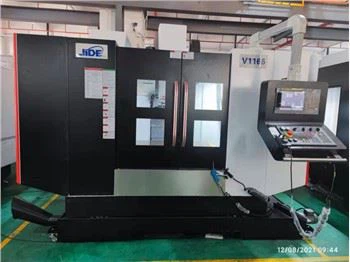
Hey there! As a supplier of Cnc Lathe Machine Slant Bed With Turret, I often get asked about all sorts of technical aspects of these machines. One question that comes up quite frequently is about backlash compensation. So, I thought I'd share what it is and why it's super important.
What is Backlash in a CNC Lathe?
First off, let's understand what backlash is. In a CNC lathe with a slant bed and turret, backlash refers to the play or movement in the mechanical components when the direction of motion changes. Picture this: when you're programming the machine to move the tool in one direction and then suddenly you tell it to go the opposite way, there's a tiny delay or "gap" in the actual movement of the tool. That gap is the backlash.
Now, this might seem like a small deal, but in the world of precision machining, it can make a big difference. For example, if you're trying to make a really accurate part, even a tiny bit of backlash can cause the finished product to be off by a fraction of a millimeter. And in industries where precision is key, like aerospace or medical device manufacturing, that's a no - no.
How Backlash Occurs
Backlash usually occurs in the lead screws and the gear systems of the CNC lathe. Lead screws are responsible for converting the rotational motion of the motor into linear motion of the tool or the workpiece. Over time, due to wear and tear, there can be some clearance between the threads of the lead screw and the nut that moves along it. This clearance is what causes the backlash.
Gears are another culprit. In the transmission system that transfers power from the motor to the various moving parts of the lathe, there's always a small amount of clearance between the teeth of the gears. When the direction of rotation changes, this clearance allows for some free movement before the gears start to engage properly in the opposite direction, resulting in backlash.
The Impact of Backlash on Machining
The effects of backlash can be pretty significant. One of the most obvious impacts is on the accuracy of the machined parts. As I mentioned earlier, even a small amount of backlash can lead to dimensional errors in the parts. This can result in parts that don't fit together properly or don't meet the required specifications.
Another issue is the surface finish of the machined parts. Backlash can cause the tool to move erratically when changing directions, leading to rough or uneven surfaces on the parts. This is a big problem, especially if the parts need to have a smooth finish for aesthetic or functional reasons.
What is Backlash Compensation?
So, how do we deal with this backlash problem? That's where backlash compensation comes in. Backlash compensation is a technique used in CNC lathes to correct for the effects of backlash. Essentially, the CNC control system is programmed to account for the amount of backlash in the machine.
When the machine is moving in one direction and then needs to change to the opposite direction, the control system will add a small amount of extra movement to make up for the backlash. This extra movement is calculated based on the measured amount of backlash in the machine. For example, if the measured backlash is 0.05 mm, the control system will add an additional 0.05 mm of movement when changing directions to ensure that the tool reaches the correct position.
Implementing Backlash Compensation
Implementing backlash compensation in a CNC lathe with a slant bed and turret isn't overly complicated, but it does require some careful measurement and programming. The first step is to measure the amount of backlash in the machine. This can be done using a dial indicator or a similar measuring tool.
Once the backlash has been measured, the value is entered into the CNC control system. The control system then uses this value to adjust the movement of the tool when changing directions. It's important to note that the backlash value may change over time due to wear and tear on the machine, so it's a good idea to periodically re - measure the backlash and update the compensation value in the control system.
Benefits of Backlash Compensation
There are several benefits to using backlash compensation in a CNC lathe. The most obvious one is improved accuracy. By compensating for backlash, the machine can produce parts that are much closer to the desired dimensions, reducing the number of rejected parts and improving the overall quality of the production.
Another benefit is better surface finish. Since the tool moves more smoothly when changing directions, the surface finish of the machined parts is improved, resulting in a more professional - looking product.
Backlash compensation also helps to increase the lifespan of the machine. By reducing the stress on the mechanical components caused by the erratic movement due to backlash, the machine is less likely to experience premature wear and tear, which can save you money on maintenance and replacement parts in the long run.
Our CNC Lathe Machines and Backlash Compensation
At our company, we take great pride in the quality of our Cnc Lathe Machine Slant Bed With Turret. All of our machines are equipped with advanced CNC control systems that support backlash compensation. We understand the importance of precision in machining, and we want to make sure that our customers can produce high - quality parts with ease.
Whether you're looking for a machine for CNC turning, or need a Large Cnc Lathe for heavy - duty work, or a Y Axis Cnc Lathe for more complex machining operations, our machines are up to the task.
Contact Us for Your CNC Lathe Needs
If you're in the market for a Cnc Lathe Machine Slant Bed With Turret, we'd love to hear from you. Our team of experts is always ready to answer any questions you might have about our machines, including how the backlash compensation works. We can also provide you with a quote based on your specific requirements.
Don't hesitate to reach out to us if you want to discuss your machining needs and see how our machines can help you improve your production process. We're committed to providing the best products and services to our customers, and we're confident that our CNC lathes will meet your expectations.


References
- Smith, J. (2020). Precision Machining Handbook. Publisher XYZ.
- Brown, A. (2019). CNC Lathe Technology. ABC Publications.