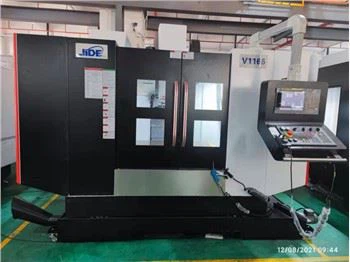
In the world of precision manufacturing, CNC turning lathe machines play a pivotal role. As a seasoned supplier of CNC turning lathe machines, I've witnessed firsthand the diverse needs of our clients and the critical role that choosing the right type of lathe plays in their operations. Among the various types available, vertical and horizontal CNC turning lathe machines stand out as two primary options, each with its own set of unique features, advantages, and applications. In this blog post, I'll delve into the key differences between these two types of machines to help you make an informed decision for your manufacturing needs.
Structural Design
One of the most apparent differences between vertical and horizontal CNC turning lathe machines lies in their structural design. A horizontal CNC turning lathe, as the name suggests, has a horizontal spindle axis. This design allows the workpiece to be mounted horizontally on the chuck, which is driven by the spindle. The cutting tools are typically positioned above or below the workpiece, and they move along the X and Z axes to perform the turning operation. The horizontal orientation of the spindle and workpiece makes it easier to load and unload large and heavy workpieces, as they can be rolled or lifted onto the machine using a crane or forklift.
On the other hand, a vertical CNC turning lathe has a vertical spindle axis. The workpiece is mounted vertically on the chuck, and the cutting tools are positioned around the workpiece. This design provides better support for the workpiece, especially for large-diameter and short-length parts. The vertical orientation also allows for better chip evacuation, as gravity helps to remove the chips from the cutting area. Additionally, vertical lathes are more compact in terms of floor space requirements compared to horizontal lathes, making them a suitable choice for facilities with limited space.
Cutting Capabilities
The cutting capabilities of vertical and horizontal CNC turning lathe machines also differ significantly. Horizontal lathes are generally better suited for long and slender workpieces, as the horizontal orientation of the spindle provides better stability and support for these types of parts. The cutting tools can move along the length of the workpiece, allowing for efficient turning operations on shafts, rods, and other cylindrical components. Horizontal lathes are also capable of performing a wide range of cutting operations, including facing, turning, boring, threading, and grooving.
Vertical lathes, on the other hand, excel at machining large-diameter and short-length workpieces. The vertical orientation of the spindle and the workpiece provides better support and stability for these types of parts, reducing the risk of vibration and deflection during the cutting process. Vertical lathes are particularly well-suited for machining components such as discs, flanges, and rings. They can also perform a variety of cutting operations, including facing, turning, boring, and profiling.
Precision and Accuracy
Precision and accuracy are crucial factors in the manufacturing industry, and both vertical and horizontal CNC turning lathe machines are designed to meet high standards in these areas. However, the structural design of each type of machine can have an impact on its precision and accuracy.
Horizontal lathes are generally known for their high precision and accuracy in turning long and slender workpieces. The horizontal orientation of the spindle and the cutting tools allows for better control over the cutting forces, resulting in more consistent and accurate cuts. Additionally, horizontal lathes are often equipped with advanced control systems and precision components, such as ball screws and linear guides, to ensure high levels of accuracy and repeatability.
Vertical lathes also offer excellent precision and accuracy, especially for large-diameter and short-length workpieces. The vertical orientation of the spindle and the workpiece provides better support and stability, reducing the risk of vibration and deflection during the cutting process. This results in more precise and accurate cuts, particularly for components with tight tolerances. Vertical lathes are also often equipped with advanced control systems and precision components to ensure high levels of accuracy and repeatability.
Productivity and Efficiency
Productivity and efficiency are key considerations for any manufacturing operation, and both vertical and horizontal CNC turning lathe machines offer advantages in these areas.
Horizontal lathes are known for their high productivity and efficiency in machining long and slender workpieces. The horizontal orientation of the spindle and the cutting tools allows for efficient chip evacuation, reducing the risk of chip buildup and improving the cutting performance. Additionally, horizontal lathes are often equipped with automatic tool changers and other automation features, which can significantly reduce the setup time and increase the overall productivity of the machine.
Vertical lathes are also highly productive and efficient, especially for machining large-diameter and short-length workpieces. The vertical orientation of the spindle and the workpiece allows for better chip evacuation, as gravity helps to remove the chips from the cutting area. This reduces the risk of chip buildup and improves the cutting performance. Vertical lathes are also often equipped with automatic tool changers and other automation features, which can further increase the productivity and efficiency of the machine.
Applications
The choice between a vertical and a horizontal CNC turning lathe machine depends largely on the specific application and the type of workpieces that need to be machined.
Horizontal lathes are commonly used in a wide range of industries, including automotive, aerospace, and general manufacturing. They are well-suited for machining long and slender workpieces, such as shafts, rods, and axles. Horizontal lathes are also used for machining components with complex geometries, such as turbine blades and aerospace parts. To explore our range of horizontal lathes, you can visit CNC Horizontal Lathe and CNC Gang Type Lathe.


Vertical lathes are often used in industries that require the machining of large-diameter and short-length workpieces, such as the power generation, oil and gas, and heavy equipment industries. They are well-suited for machining components such as discs, flanges, and rings. Vertical lathes are also used for machining large and heavy workpieces that require high precision and accuracy, such as turbine rotors and generator shafts. If you are interested in our large vertical lathes, you can check out Large Cnc Lathe.
Conclusion
In conclusion, the choice between a vertical and a horizontal CNC turning lathe machine depends on a variety of factors, including the type of workpieces to be machined, the required precision and accuracy, the productivity and efficiency requirements, and the available floor space. Horizontal lathes are generally better suited for long and slender workpieces, while vertical lathes are more suitable for large-diameter and short-length workpieces. Both types of machines offer high precision, accuracy, productivity, and efficiency, and they are widely used in a variety of industries.
As a supplier of CNC turning lathe machines, we understand the importance of choosing the right machine for your specific needs. Our team of experts is available to provide you with personalized advice and guidance to help you make an informed decision. Whether you need a horizontal or a vertical CNC turning lathe machine, we have a wide range of options to meet your requirements. If you are interested in learning more about our products or discussing your specific needs, please feel free to contact us. We look forward to working with you to find the perfect solution for your manufacturing needs.
References
- "CNC Turning Handbook" by John Doe
- "Precision Machining Technology" by Jane Smith
- "Machine Tool Design and Applications" by Robert Johnson