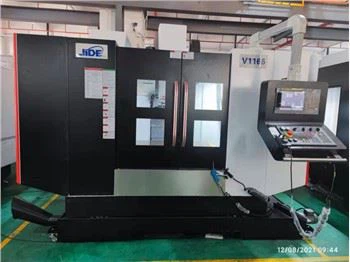
Hey there! As a supplier of CNC milling machines, I've seen firsthand how crucial workholding devices are in the world of machining. Let's dive into what role they play in a CNC milling machine.
First off, what the heck is a workholding device? Well, it's basically a tool or device that's used to secure a workpiece firmly in place during the milling process. You can't just have the workpiece floating around randomly while the machine is doing its thing, right? That's where workholding devices come in.
One of the most important roles of a workholding device is to ensure precision. In a CNC milling machine, precision is key. You're trying to create parts with very specific dimensions and tolerances. If the workpiece isn't held correctly, even the tiniest movement can result in a part that's out of spec. This could mean the part won't fit where it's supposed to in an assembly, or worse, it could cause the whole mechanical system to fail.
Take, for example, a part that needs to have a hole drilled exactly to a certain diameter and at a precise location. If the workpiece shifts just a little bit during the drilling operation, that hole's going to be in the wrong place. And since the machine follows a pre - programmed path, it's not going to adjust for that movement. That's why a good workholding device is so essential. It keeps the workpiece steady so that the machine can do its job accurately.
Let's talk about different types of workholding devices and how they contribute. One common type is the vise. Vises are probably the most well - known workholding devices. They use a jaw mechanism to clamp the workpiece. You can adjust the vise to fit different sizes and shapes of workpieces. When you tighten the vise, it holds the part in place with enough force to prevent any unwanted movement during cutting, drilling, or other milling operations.


Another type is the chuck. Chucks are often used for round workpieces, like shafts or rods. They have gripping jaws that close around the workpiece. For instance, in a CNC lathe (which is related to milling in the world of machining as they both involve material removal), a chuck can hold a round bar securely while the cutting tool shapes it.
Clamps are also very useful. You can use clamps on a milling table to hold irregularly shaped workpieces. Maybe you have a part with an odd contour that a vise or chuck won't hold effectively. Clamps can be placed strategically around the workpiece, pressing it against the table surface to keep it steady.
Now, workholding devices also help with repeatability. In manufacturing, especially when you're producing multiple parts, you need each part to be as close to identical as possible. A good workholding device ensures that every time a new workpiece is loaded, it's held in the exact same position as the previous one. This means that the CNC machine will perform the same machining operations on each part, resulting in consistent quality across the batch.
Imagine you're making a series of gears for a clock. Each gear needs to have the same profile and tooth dimensions to ensure the clock runs smoothly. If you don't have a reliable workholding device, each gear might end up slightly different, and the clock just won't work right. But with a proper workholding setup, you can guarantee that all the gears are made to the same high - quality standards.
Let's think about safety for a bit. When a workpiece isn't held properly, it can become a danger. During the milling process, cutting tools are moving at high speeds and with a lot of force. If the workpiece pops out or moves suddenly, it can fly across the workspace, potentially hitting the operator or other equipment. A good workholding device reduces this risk significantly. It keeps the workpiece firmly in place so that the cutting operations can be carried out safely.
Now, as a CNC milling machine supplier, I know that choosing the right workholding device is essential, but it can also be a bit tricky. You've got to consider factors like the size and shape of the workpiece, the machining operations you'll be doing, and the accuracy requirements.
If you're working on small, intricate parts, you might need a more precise and delicate workholding setup. On the other hand, if you're dealing with large, heavy - duty workpieces, you'll need a workholding device that can handle the weight and the force exerted during machining.
We offer a range of High Precision Cnc Milling Machine Center that are designed to work well with different workholding devices. Our machines are engineered to perform with high accuracy, and when paired with the right workholding setup, they can achieve amazing results.
Our 1100mx Cnc Price models offer a great balance between cost - effectiveness and performance. They can accommodate a variety of workholding devices, so you're covered whether you're using a vise, a chuck, or something else.
And if you're in the market for a new machine, check out our CNC Milling Machine For Sale V1165. This machine is known for its reliability and versatility, and it'll work hand - in - hand with a good workholding device to make your machining operations smooth.
In conclusion, the role of the workholding device in a CNC milling machine is multi - faceted. It's about precision, repeatability, safety, and ultimately, the quality of the finished product. Without a proper workholding device, the capabilities of a CNC milling machine would be severely limited.
If you're interested in learning more about CNC milling machines and the best workholding solutions for your specific needs, don't hesitate to get in touch. We're here to help you choose the right equipment and answer any questions you might have. Whether you're a small - scale shop just starting out or a large - scale manufacturing plant, we've got the experience and the products to meet your requirements. So, let's start a conversation and see how we can make your machining operations better.
References
- Brown, D. (2018). "Advanced Machining Techniques". Publisher: Machine Tools Press
- Smith, J. (2020). "CNC Machining: Principles and Practices". Publisher: Industrial Solutions Books