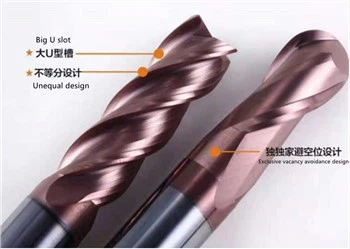
What is the tolerance of endmills?
As a seasoned supplier of endmills, I've often been asked about the tolerance of endmills. Tolerance is a critical concept in the manufacturing and machining industry, especially when it comes to endmills. In this blog post, I'll delve into what endmill tolerance is, why it matters, and how it impacts your machining operations.
Understanding Tolerance in Endmills
Tolerance, in the context of endmills, refers to the allowable deviation from a specified dimension. Every endmill is designed with specific dimensions for its diameter, length, and other critical features. However, due to the limitations of manufacturing processes, it's impossible to produce an endmill with exact dimensions every time. Tolerance defines the range within which these dimensions can vary while still being considered acceptable.
For example, if a Ball Nose End Mill is specified to have a diameter of 10 mm, the tolerance might be ±0.01 mm. This means that the actual diameter of the endmill can be anywhere between 9.99 mm and 10.01 mm and still meet the quality standards.
Types of Tolerances in Endmills
There are several types of tolerances that are relevant to endmills:
Diameter Tolerance
The diameter tolerance is one of the most crucial tolerances in an endmill. It directly affects the size of the hole or slot that the endmill will cut. A larger diameter tolerance can result in holes or slots that are either too large or too small, which can lead to fit issues in the final product. For precision machining, tight diameter tolerances are often required to ensure the accuracy of the machined parts.
Length Tolerance
Length tolerance refers to the allowable variation in the length of the endmill. While it may not seem as critical as diameter tolerance in some applications, it can still have an impact on the machining process. For example, if the endmill is too long, it may cause excessive vibration or chatter during cutting, which can affect the surface finish of the machined part. On the other hand, if the endmill is too short, it may not be able to reach the desired depth of cut.
Helix Angle Tolerance
The helix angle of an endmill affects the chip evacuation and cutting performance. A tolerance in the helix angle can change the way the endmill cuts and the quality of the chips produced. A larger helix angle tolerance can lead to inconsistent chip formation and potentially affect the surface finish of the machined part.
Cutting Edge Tolerance
The cutting edge of an endmill is where the actual cutting takes place. Tolerances in the cutting edge geometry, such as the rake angle and clearance angle, can significantly impact the cutting performance and tool life. A small deviation in these angles can cause the endmill to cut less efficiently, generate more heat, and wear out faster.
Why Tolerance Matters
Precision Machining
In industries such as aerospace, automotive, and medical, precision is of utmost importance. Parts need to be machined to very tight tolerances to ensure proper fit and function. Endmills with accurate tolerances are essential for achieving the required precision in these applications. For example, in aerospace components, a small deviation in the dimensions of a part can have serious consequences for the safety and performance of the aircraft.
Tool Life
Tolerance also affects the tool life of endmills. When an endmill is within the specified tolerance, it cuts more efficiently and experiences less wear and tear. On the other hand, an endmill with a large tolerance may not cut properly, leading to increased friction, heat, and premature tool failure. By using endmills with tight tolerances, you can extend the tool life and reduce the frequency of tool changes, which can save time and money in the long run.
Surface Finish
The surface finish of a machined part is another important factor that is influenced by endmill tolerance. A well-toleranced endmill cuts more smoothly and produces a better surface finish. In applications where a high-quality surface finish is required, such as in the production of optical components or molds, using endmills with tight tolerances is crucial.
How We Ensure Tolerance in Our Endmills
As a supplier of endmills, we understand the importance of tolerance and take several measures to ensure that our endmills meet the highest quality standards.
Advanced Manufacturing Processes
We use state-of-the-art manufacturing equipment and techniques to produce our endmills. Our manufacturing processes are carefully controlled to minimize variations in dimensions and ensure that each endmill is within the specified tolerance. For example, we use high-precision grinding machines to achieve accurate diameters and cutting edge geometries.
Quality Control
We have a rigorous quality control system in place to inspect every endmill before it leaves our facility. Our quality control team uses advanced measuring instruments, such as micrometers, calipers, and optical measuring systems, to check the dimensions and tolerances of the endmills. Any endmill that does not meet the specified tolerance is rejected and sent back for rework or disposal.


Continuous Improvement
We are committed to continuous improvement and are constantly looking for ways to enhance the quality of our endmills. We invest in research and development to improve our manufacturing processes and develop new technologies that can further reduce tolerances and improve the performance of our endmills.
Impact of Tolerance on Different Types of Endmills
Ball End Mill
Ball end mills are commonly used for contouring and 3D machining. The tolerance of a ball end mill is critical for achieving smooth and accurate contours. A small deviation in the diameter or radius of the ball end can result in a visible step or imperfection in the machined surface. Therefore, tight tolerances are required for ball end mills to ensure high-quality machining results.
Carbide End Mill For Aluminum
When machining aluminum, the tolerance of the endmill can have a significant impact on the cutting performance. Aluminum is a soft material, and a well-toleranced endmill can cut through it more smoothly, producing fewer chips and a better surface finish. A large tolerance in the endmill can cause the cutting edges to rub against the aluminum, leading to increased heat, tool wear, and poor surface quality.
Conclusion
In conclusion, the tolerance of endmills is a crucial factor that affects the precision, tool life, and surface finish of machined parts. As a supplier of endmills, we understand the importance of tolerance and are committed to providing our customers with high-quality endmills that meet the strictest tolerance requirements. Whether you are in the aerospace, automotive, medical, or any other industry that requires precision machining, our endmills can help you achieve the best results.
If you are interested in learning more about our endmills or have any questions about tolerance, please feel free to contact us. We would be happy to discuss your specific requirements and provide you with the best solutions for your machining needs.
References
- ASME Y14.5 - Dimensioning and Tolerancing Standard
- ISO 286 - Geometrical Product Specifications (GPS) - Linear Sizes - Tolerance Grades and Deviation Tables
- Machinery's Handbook, 31st Edition