


cnc vertical machining centre machine
The XYZ axis adopts the overall sliding structure of the slider to ensure the X axis accuracy and processing rigidity.
Taiwan high-speed gearbox spindle is 10000rpm. ※Taiwan famous brand..
Dongguan Jide Precision Machinery Technology Co., Ltd. is one of the most credible manufacturers and suppliers of cnc vertical machining centre machine in China. If you're going to wholesale high quality cnc vertical machining centre machine made in China, welcome to get quotation and free sample from our factory. All customized products are with high quality and competitive price.
Why do precision cnc vertical machining centre machine need to be scraped?
When you pass by a machine tool factory and see the technicians using manual scraping, you can't help wondering: "Can they really improve the current machined surfaces by scraping? (People will Is it better than a machine?)"
If you mean purely its appearance, then our answer is "no", we won't do it more beautifully, but why bother to scratch it? Of course there are reasons for it, one of which is the human factor: the purpose of machine tools is to manufacture other machine tools, but it can never replicate a product that is more accurate than the original. Therefore, if we want to make a machine that is more accurate than the original machine, we must have a new starting point. In other words, we must start with human effort. In this case, human effort refers to Scrape and grind by hand.

Scraping is not a "hands-on" or "arbitrary" work. It is actually a method of copying, almost perfectly copying the matrix. This matrix is a standard plane and is also made by hand.
Although scraping is laborious and laborious, it is a skill (art-level technique); it may be more difficult to train a scraping master than to train a woodcarver. There are not many books on the market that discuss this topic. In particular, there is less information on the topic of "Why Scraping Research". This may be why scraping is regarded as an art.
01
Where to start?
If a manufacturer decides to grind with a grinder instead of scraping, the accuracy of the guide rails of his "mother machine" grinder must be higher than that of the newly built grinder.
So, where did the accuracy of the first machine come from?
It must be from a more precise machine, or to rely on another method that can produce a truly flat surface, or it may be copied from a flat surface that has been done well.
We can use three ways of drawing circles to illustrate the process of surface production (although circles are lines rather than surfaces, they can be cited to illustrate concepts). A craftsman can use an ordinary compass to draw a perfect circle; if he uses a pencil to trace a round hole on the plastic template, he will copy all the inaccuracy of the hole; if he draws freehand In the case of a circle, the accuracy of the circle is determined by his limited skills.
Theoretically, a perfectly flat surface can be produced by alternating friction (lapping) of three surfaces. For the sake of simplicity, let's use three rocks each with a fairly flat surface to illustrate. If you rub the three planes alternately in a random order, you will make the three planes smoother and smoother. If you rub only two rocks, you will get a concave and convex mating pair. In practice, in addition to using squeegee instead of Lapping (Lapping), a clear matching sequence will also be followed. Masters of squeegee generally use this rule to make the standard fixture (straight gauge or flat plate) he wants to use. .
When in use, the master scraper will first apply the developer on the standard fixture, and then slide it on the surface of the workpiece to expose the area that needs to be shoveled off. He keeps repeating this action, the surface of the workpiece will get closer and closer to the standard jig, and in the end it can perfectly replicate the same work as the standard jig.
The castings to be scraped are usually processed by milling to a few thousandths of the final size, then sent to heat treatment to release the residual pressure, and then sent back for finishing surface grinding before scraping. Although scraping takes a lot of time and labor costs, scraping can replace the process that requires high equipment costs. If you don’t want to replace it with scraping, the workpiece must be finished with a high-precision and expensive machine. Repair processing.
In addition to the high-cost equipment involved in the final stage of finishing processing, there is another factor that needs to be considered: when parts are processed, especially large castings, some gravity clamping is often necessary. When the processing reaches a few thousandths For precision, this clamping force often causes distortion of the workpiece, so as to endanger the accuracy of the workpiece after the clamping force is released; the heat generated during processing will also cause the distortion of the workpiece.
This is one of the many advantages of scraping. There is no clamping force and the heat generated by scraping is almost zero. The large workpiece is supported by three points to ensure that it will not be deformed due to its own weight.
When the scraping track of the machine tool wears out, it can be re-corrected by scraping again, which is a great advantage compared to discarding the machine or sending it to the factory for disassembly and processing.
When the track of a machine tool needs to be scraped again, this job can be done by the maintenance staff of the factory, but we can also find someone in the local area to do the scraping again.
In some cases, manual scraping and electric scraping can be used to obtain the final required geometric accuracy. If there is a set of workbench and saddle track that has been scraped and the accuracy has met the requirements, but the parallelism of the workbench to the spindle is found to be out of specification (it takes a lot of work to correct), you can imagine using only one scraper. Without losing the flatness and properly correcting the alignment error, is it possible to remove the correct amount of metal at the correct position. What level of technology is needed?
This is of course not the original purpose of scraping and should not be used as a method to correct large alignment errors. However, a skilled scraping master can complete this type of correction in a surprisingly short time. Although this method requires skilled technology, it is more economical than processing a large number of parts to be very accurate, or to make some reliable or adjustable designs in order to prevent alignment errors.
02
Improvement of lubrication
Practical experience has proved that the scraping track can reduce friction through better quality lubrication, but everyone is not sure why it is. The most common opinion is that scraping the low points (or more specifically, the pits that are cut out, the oil bags made more for lubrication) provide many tiny oil storage pockets, which will be trapped by the many tiny high Scratch it out.
Another logical statement is that it allows us to continuously maintain a layer of oil film, allowing moving parts to float on the oil film, which is the goal of all lubrication. The main reason why this happens is that these irregular oil bags form a lot of oil-retaining space, making it difficult for the oil to escape. The ideal situation of lubrication is to maintain an oil film between two perfectly smooth surfaces, but then you have to deal with the problem of preventing the oil from flowing out, or you need to add it as soon as possible. (Regardless of whether there are shoveling on the track surface, oil grooves are usually made to help oil distribution).
Such a statement will make people question the effect of the contact area. Scraping reduces the contact area, but it will form a uniform distribution, and the distribution is the key. The flatter the two matching surfaces, the more even the distribution of the contact surfaces. But there is a principle in mechanics that "friction has nothing to do with area". This sentence means that no matter the contact area is 10 or 100 square inches, the same force is required to move the table. (Abrasion is another matter. The smaller the area under the same load, the faster the abrasion.)
The point I want to say is that what we are after is a better lubrication effect, not more or less contact area. If the lubrication effect is flawless, the track surface will never wear out. If a workbench is difficult to move due to wear, it may be related to lubrication, not to the contact area.
03
How is scraping done?
Before finding the high point that must be scraped off, first apply the developer on the standard fixture (a flat plate or a straight fixture when shoveling the V-rail), and then put the standard fixture coated with the developer on the standard fixture. If the track surface to be shoveled is rubbed, the color developer will be transferred to the high points of the track surface, and then a special scraping tool will be used to remove the high points of the color. This action has to be repeated until a uniform transition appears on the track surface.
Of course, a scraper must know all kinds of techniques. I will talk about two of them first.
First, we usually use a dull file to gently rub the surface of the workpiece to remove the burrs before doing the color development.
Second, wipe the surface with a brush or hand, never wipe with a rag. If you use a cloth to wipe, the thin linen thread left by the cloth will cause a misleading mark the next time the high-point color is displayed.
The scraping master himself will check his work by comparing the standard jig with the track surface. The inspector only needs to tell the scraping master when he can stop the work, and he doesn't have to worry about the scraping process. (Master scraper can be responsible for the quality of his work)
In the past, we had a set of standards that stipulated how many high points per square inch should have and what percentage of the total area should be the contact rate; but we found that checking the contact area is almost impossible, and now it is all caused by scratching. The researcher decides the number of points per square inch. In short, the scraper will generally strive to achieve the standard of 20-30 points per square inch.
In the current scraping process, some leveling operations use electric scraping machines. They are also a kind of manual scraping, but they can eliminate some laborious tasks and make the scraping work less tiring. When you are doing the most delicate assembly work, the feeling of manual scraping is still irreplaceable.


cnc vertical machining centre machine Performance characteristics :
※The XYZ axis adopts the overall sliding structure of the slider to ensure the X axis accuracy and processing rigidity.
※Taiwan high-speed gearbox spindle is 10000rpm.
※Taiwan famous brand disc-type tool magazine, with a capacity of 24 tools, the manipulator can change the tools, the action is reliable, and the tool is changed quickly.
※The cooling system uses a large flow, high-lift water pump to ensure sufficient cooling under high-speed cutting.
Standard configuration
※FANUC Oi MF、
Taiwan famous brand 24 rounds
WEDA
Disc tool magazine
Select configuration
※Siemens 828D, FANUC 0iMF
※CNC fourth and fifth axis
※Automatic chip removal system
Detail display of cnc vertical machining centre machine
The enhanced tool holder can be customized. Make the body durable and not deformed
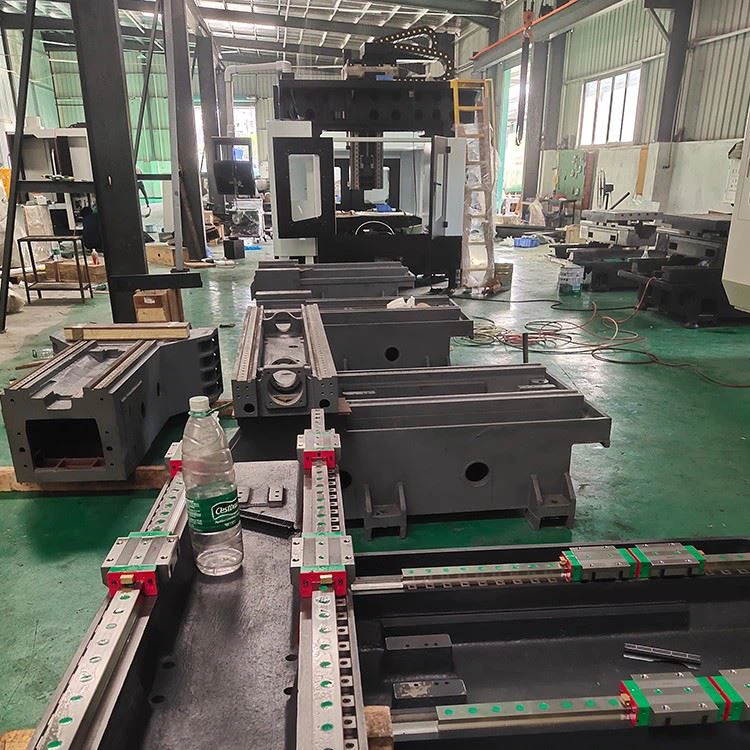
The whole body is made of high-quality resin sand wear-resistant castings, which are strong and tough.
Details pictures


Parameters

CNC vertical machining centre machine main structure is made of high-grade cast iron. The three-axis rail supports rapid movement to ensure accurate positioning.
High-speed silent screw, silent line rail, less thermal deformation and high precision.


Precautions for CNC center 1370 startup, standardize startup operation
CNC means numerical control. The CNC vertical machining centre machine, which is most popular in the past ten years, has penetrated into many fields of the machining industry. CNC machining has become a wide range of machining methods now, and it will definitely become a trend in the future. Numerical control will also become a major factor in the level of overhaul machining.
A CNC machining center enters the power-on link after turning on the button, clamping the workpiece, preparing the tool, and setting the parameters. Then, what matters should be paid attention to in this link?
1. Tool and feed
Each program execution of the machining center requires the participation of the tool, and the tool must be carefully inspected to ensure that it is consistent with the tool specified in the process. At the beginning of processing, the feed speed should be adjusted to the minimum, and the method of single block execution-rapid positioning-tool drop should be adopted. You must pay attention when entering the tool and place your hand on the stop button. If a problem is found, it must be stopped immediately.
2. Open thick
Roughing is a term in the machining industry, which means the initial machining of a rough workpiece. When the workpiece is roughened, the operator should not be too far away from the console, so as to ensure that the machine will be shut down for inspection in an emergency. In the roughing process, it is necessary to continuously optimize the processing settings and parameters according to the actual processing conditions to achieve the best results. Roughing is a very important processing procedure. After processing, it is necessary to measure whether the main size values are consistent with the drawing requirements, and the inspector must be sent to the inspector for special inspection before proceeding to the next processing.
3. Hole processing
Hole machining is a common machining operation in machining centers. Common processing methods include drilling, reaming, and boring. This type of processing is generally divided into three steps: the first step is to use a center drill to locate the hole, then use a drill with a diameter of 0.5 to 2 mm smaller than the drawing to drill, and finally use a suitable drill, reamer, and boring tool. Perform finishing.
4. Numerical control system
We know that before the CNC machining starts, the workpiece must be clamped, set the zero position, set the machining parameters, open the machining program to be processed in the computer to check the number of revolutions, and then let the computer enter the DNC state, and enter the correct machining program file name. You need to press the TAPE button and the start button in sequence, and then the flashing LSK will appear on the control screen of the machining center. At this time, press Enter to start distributed CNC machining.
A good start is half the battle, and a standardized start-up operation is the beginning of efficient and safe order completion. I hope you can master the above precautions in practice so that the processing center can better serve us.
Hot Tags: cnc vertical machining centre machine, China, suppliers, manufacturers, factory, price, for sale, made in China, 5 Axis Cnc Machining Center, Best Vertical Machining Center
You Might Also Like




Send Inquiry