


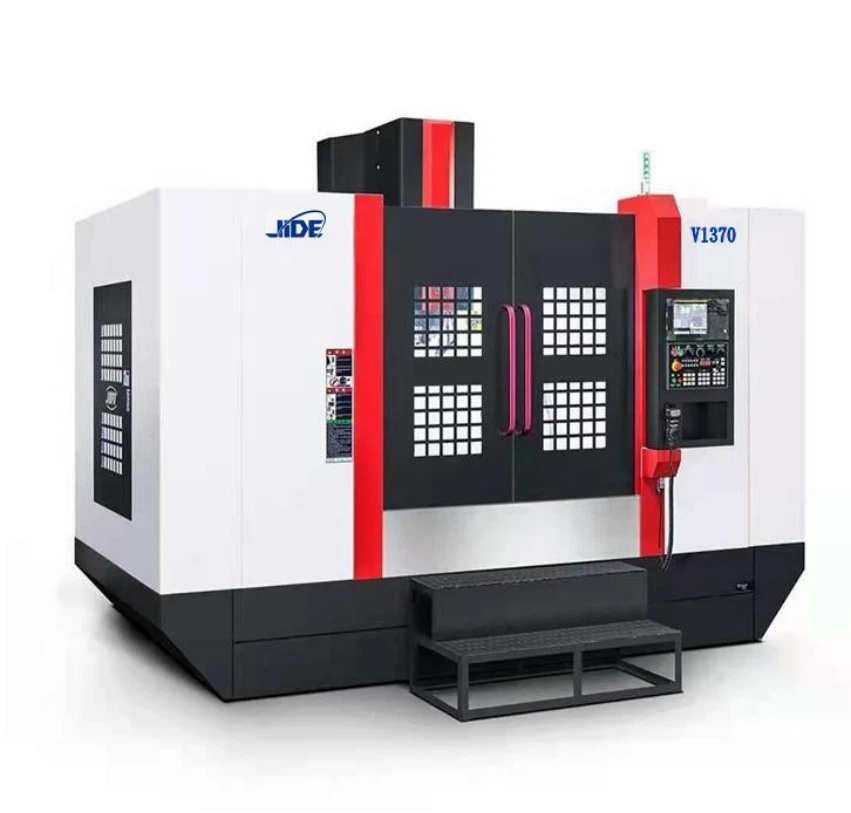
Large Cnc Milling Machine
Y-axis travel mm 800
Z-axis travel mm 800
Spindle nose to worktable mm 110~910
Spindle center to column guide mm 900
Work table
Work table size (length x width) mm 1500*800
T-slot (number - size * spacing) mm 7*18X105
Dongguan Jide Precision Machinery Technology Co., Ltd. is one of the most credible manufacturers and suppliers of large cnc milling machine in China. If you're going to wholesale high quality large cnc milling machine made in China, welcome to get quotation and free sample from our factory. All customized products are with high quality and competitive price.


|
Configuration |
Unit |
V1380 |
||
|
● |
Travel |
|
|
|
|
X-axis travel |
mm |
1300 |
||
|
Y-axis travel |
mm |
800 |
||
|
Z-axis travel |
mm |
800 |
||
|
Spindle nose to worktable |
mm |
110~910 |
||
|
Spindle center to column guide |
mm |
900 |
||
|
● |
Work table |
|
|
|
|
Work table size (length x width) |
mm |
1500*800 |
||
|
T-slot (number - size * spacing) |
mm |
7*18X105 |
||
|
Maximum load |
Kg |
1500 |
||
|
Spindle |
|
|
||
|
Spindle speed |
rpm |
10000 |
||
|
Spindle motor power |
kw |
11/15 |
||
|
Spindle taper (model / installation size) |
BT40(150) |
|||
|
● |
Feed |
|
|
|
|
G00 fast feed (X axis) |
m/min |
30 |
||
|
G00 fast feed (Y axis) |
m/min |
30 |
||
|
G00 fast feed (Z axis) |
m/min |
30 |
||
|
G01 cutting feed |
m/min |
10/10/10 |
||
|
● |
Machine accuracy |
|
|
|
|
Positioning accuracy |
mm |
0.005/300 |
||
|
Repeat positioning accuracy |
mm |
0.005/300 |
||
|
● |
Others |
|
|
|
|
Floor space (length) |
mm |
3900 |
||
|
(width) |
mm |
3300 |
||
|
Machine height (height) |
mm |
3550 |
||
|
Machine weight |
Kg |
9000 |
||
|
Vacuum packaging |
T |
Export |
||
|
Wooden frame fixing |
T |
Export |
||


What exactly is the "hardness" of metal?
Hardness, as an important performance indicator of metal materials by Large Cnc Milling Machine, is like the character of the material, which directly affects its application performance in the manufacturing industry. However, what exactly is "hardness"? How to better understand it? Today, let's talk about the hardness of metal materials in a simple and easy-to-understand way.
01 What is hardness?
Hardness, in simple terms, is the ability of a material to resist external mechanical forces (such as indentation, scratching, shearing, etc.). Materials with high hardness are more "hard", just like more durable warriors, they can withstand the wear of blades, the impact of machines, and can maintain their shape under high pressure; materials with low hardness are relatively "soft" and easily deformed or damaged.
Hardness can reflect the damage resistance of the surface and structure of the material, but it is different from properties such as strength, toughness, and plasticity. For example, glass has a high hardness and is not easy to be scratched, but it is very brittle and easy to break after impact, while metals can find an ideal balance between hardness and toughness.
Hardness runs through almost the entire manufacturing process and is the "core indicator" of material performance. In the manufacturing industry, hardness helps us solve these problems:
1) Is the material wear-resistant enough? For example, if the hardness of molds and tools is too low, the life span will be short.
2) Is the processing performance good? For example, in turning and milling, the hardness of the workpiece determines the wear rate of the tool; in stamping, the hardness of the material is directly related to the life of the mold and the processing quality.
3) How is the quality of the finished product? For example, whether the surface of the gear is hard enough affects its durability.
02 Three major hardness testing methods: Who is the C position in the hardness world?
Speaking of hardness testing, the three most commonly used methods in the industry are: Brinell hardness (HB), Rockwell hardness (HR), and Vickers hardness (HV). They are like three judges, each with its own style, but they can help us accurately judge the "hardness value" of the material.
1. Brinell hardness (HB): Steady strongman
The Brinell hardness test method is very simple: use a steel ball or carbide ball to press into the surface of the material under a certain pressure, and take the diameter of the indentation to calculate the hardness value. This method is suitable for testing metals with low or medium hardness, such as cast iron, steel, etc.
Features: The Brinell hardness test is more suitable for large pieces of materials, with large indentations and stable data, but it is not suitable for materials with high hardness.
Analogy in life: It is like using a round stone to press an imprint on the sand. The shallower the imprint, the higher the "hardness" of the sand.
Application in manufacturing: Brinell hardness is suitable for the hardness assessment of large-sized metal materials, especially in the quality control of castings and forgings. For example, when manufacturing large-scale engineering machinery parts, Brinell hardness can accurately reflect the overall deformation resistance of the workpiece.
Actual case: Cast iron workpieces usually need to be tested for Brinell hardness before lathe processing. If the hardness is too low, the surface roughness may not meet the requirements during processing; if the hardness is too high, it is easy to accelerate the wear of the tool.
2. Rockwell hardness (HR): agile all-rounder
Rockwell hardness is a more flexible test method. It uses different indenters and test loads to suit a variety of materials from soft to hard, with fast test speed and easy operation. Its hardness value is calculated by measuring the depth of the indenter, which is more suitable for testing small parts or surface hardened layers than Brinell hardness.
Features: wide range of applications, fast test speed, very suitable for rapid detection on industrial sites.
Analogy in life: just like you draw lines on paper with pencils of different strengths, the deeper the pen tip presses, the lower the "hardness" of the paper looks.
Manufacturing application: Rockwell hardness is widely used on production lines because of its fast test speed and easy operation. Especially for parts after surface quenching treatment, it is necessary to test whether they meet the design requirements. If the hardness is not enough, it may be easy to wear; if it is too hard, the inner layer is easy to crack, so Rockwell hardness testing is an indispensable part.
Actual case: When manufacturing gears, in order to improve wear resistance, surface high-frequency quenching treatment is usually performed. The surface hardness of the gear after quenching needs to be tested by Rockwell hardness test to ensure that its hardness meets the design requirements and that the inner layer has good toughness, thereby taking into account both wear resistance and impact resistance.
3. Vickers Hardness (HV): A Precise Scholar
The Vickers hardness test uses a pyramid-shaped diamond indenter to press a diamond-shaped indentation on the surface of the material, and the hardness value is obtained by calculating the length of the diagonal of the indentation.
Features: The Vickers hardness test is applicable to all metal materials, especially for testing small areas, such as thin films or coatings.
Analogy in life: It is like poking a mark on a cookie with a sharp toothpick. The shallower the mark, the higher the "hardness" of the cookie.
Application in manufacturing: The Vickers hardness test is suitable for hardness measurement of thin materials or small areas due to its high precision. In the manufacturing industry, the Vickers hardness method is usually used to test the hardness of coatings or heat-treated layers.
Actual case: In the manufacture of cutting tools, the coating hardness of carbide inserts is a key indicator that determines their life. Through the Vickers hardness test, it can be detected whether the hardness of the coating meets the requirements of processing high-hardness materials, thereby optimizing cutting efficiency.
03 How does hardness affect the manufacturing process?
Hardness and manufacturing processes are inextricably linked. From raw materials to processing methods, every step is inseparable from its influence.
1. Hardness affects cutting processing
In cutting processing, the hardness of the workpiece is closely related to the choice of tool material. If the hardness is too high, the tool will wear quickly; if the hardness is too low, the processing efficiency will be low and the surface roughness will not be good.
Classification of tool materials: 1) High-speed steel tools: moderate hardness, used to process ordinary steel; 2) Carbide tools: high hardness, used to process difficult-to-cut materials; 3) Coated tools: the tool surface has a high-hardness coating, suitable for efficient processing. 2. Hardness and heat treatment process
Heat treatment is an important method for adjusting hardness in the manufacturing industry, such as quenching, tempering and carburizing.
Application cases: 1) Gears: high surface hardness, wear resistance; low internal hardness, toughness, and impact resistance; 2) Molds: high-hardness materials extend the life of the mold and reduce the frequency of replacement; 3) Springs: moderate hardness, both elastic and not easy to fatigue.
3. Hardness and surface treatment
Some key parts require special surface treatment to increase hardness, such as shot peening, nitriding or coating processes. Actual example: The surface hardness of stamping dies is usually increased to above 700HV, which can greatly improve wear resistance and reduce the trouble of frequent die replacement.
04 Hardness comparison table
Vickers hardness, Brinell hardness, Rockwell hardness comparison table, save it now!

Hot Tags: large cnc milling machine, China, suppliers, manufacturers, factory, price, for sale, made in China, cnc machining center, vertical cnc machine, cnc milling milling manufacturing, Heavy Duty Cnc Vertical Milling Machine, 5 axis cnc milling machine, cnc vertical milling machine 5 axis
Previous
No InformationYou Might Also Like


Send Inquiry