


Today's post is short, but after reading it, you won't be left speechless the next time someone talks cars with you. For instance, if someone claims a "V6 just means six cylinders lined up vertically," you'll immediately know they don't really understand the subject.
From affordable daily drivers costing tens of thousands to supercars worth tens of millions, the engine's layout is always the result of careful engineering trade-offs.
I. Inline Engines: The Ubiquitous "Standard"
Let's start with the most common type: the inline engine. It powers the vast majority of family cars you see on the street.
Inline-4 Engine
Inline-4
The cylinders are arranged in a straight row-like meat on a skewer-sharing a single cylinder head and camshaft assembly. The structure is simple and cost-effective; mechanics could fix them with their eyes closed. The Toyota Corolla (1.5L), Nissan Sylphy (1.6L), and Haval H6 (1.5T) you drive all use L4 engines.
Inline-6 vs. V6: Which 6-Cylinder Engine is Better?
Inline-6
However, things get tricky as the cylinder count rises. An inline-6 (L6) engine is long-resembling a baguette-so it can't fit sideways (transversely) into the engine bay; it has to be mounted lengthwise (longitudinally). That is why BMW's longitudinal, rear-wheel-drive platform became the perfect stage for the inline-6.
The inline-6 has an inherent advantage: it naturally balances both primary and secondary vibrations, eliminating the need for balance shafts. When you sit in a BMW 540i, the smooth, refined vibration felt through the soles of your feet and the linear acceleration embody the unique charm of the inline-6-it's as smooth as silk.
II. V-Type Engines: An Elegant Choice for High Horsepower
Want high horsepower without a massive bulge in the hood? That's where V-type engines come in.
10 Greatest Six-Cylinder Engines of All Time
V6 Engine
Two banks of cylinders are angled to form an inverted "V" shape. A V6 engine is roughly the same length as a three-cylinder engine, yet it produces an exhaust note that gives you goosebumps. Have you ever heard a Mercedes-AMG G-Wagen (the "Big G") rev its V8? That deep, rumbling vibration resonates all the way from your chest to the top of your skull. Volvo Unveils All-New 5.0L V8 Engine Designed for Supercars
V8 Engine
V6 engines typically feature a 60-degree bank angle, whereas V8s use a 90-degree angle. This configuration makes the engine shorter and more compact.
However, the trade-off is the need for two cylinder heads, which can be hard on the wallet when it comes to repairs. Replacing a spark plug on a Mercedes-Benz S450, for instance, requires extensive disassembly, with labor costs often exceeding the price of the spark plug itself.
The Mustang's 5.0L V8, the Lexus LS500's twin-turbo V6, and the Panamera's V8 all follow this design philosophy. For American muscle cars and German luxury flagships, the V-configuration is a signature hallmark.
III. The VR6 Engine: A Stroke of Genius by Volkswagen Engineers
Volkswagen took an even bolder approach, aiming to shoehorn a six-cylinder engine into a compact car like the Golf.
A standard V6 was too wide for the transverse engine bay, while an inline-6 (L6) was too long. Engineers had a "eureka" moment and created the VR6: they compressed the bank angle to just 15 degrees. The cylinders were staggered and tightly packed-shorter than an inline-6 and narrower than a V6-allowing it to fit snugly into the Golf R32.
It had the appearance of an everyday runabout but housed the heart of a sports car. The 2003 R32 could sprint from 0 to 100 km/h in just over six seconds-outpacing even the Civic Type R.
Technical Analysis of Volkswagen's VR6 Engine – Sina Auto
VR6 Engine
Volkswagen later installed the VR6 in the Tiguan R and top-spec CC models. In the Chinese market, the 2.8L version featured a 15-degree angle, while the 3.6L version narrowed it to just 10.6 degrees. Yet, most consumers in China were only familiar with the 1.8T and 2.0T engines and had no idea just how impressive this "flattened V6" really was.
Sadly, Volkswagen's final VR6 engine rolled off the assembly line in Germany in December 2024, marking the end of a 33-year legacy.
IV. The Flat Engine (Boxer): The Secret to Hugging the Road
Then there is the flat engine (or "boxer" engine), where the cylinders lie horizontally at 180 degrees, opposing each other.
This lowers the center of gravity to near-floor levels, making the wheels feel glued to the road during cornering. Why is the Subaru Impreza WRX STI so stable in rally racing? Its chassis hugs the road so tightly that it feels like you're driving a remote-controlled car.
The Porsche 911 has stuck with the flat-engine (boxer) layout for decades precisely because it keeps the center of gravity lower than even a Ferrari, allowing for absurdly high cornering limits.
Flat-Engine (Boxer Engine) – What is a Flat-Engine? – Pacific Auto Encyclopedia
Flat-Engine (Boxer Engine)
People used to think this was the exclusive domain of imported brands, but now BYD's Yangwang U7 has put this technology into mass production. Its plug-in hybrid version features a 2.0T flat-engine that stands only 420mm tall-nearly half the height of a traditional inline engine. When you take it through highway ramps or over bridges, the body remains as stable as a train on tracks.
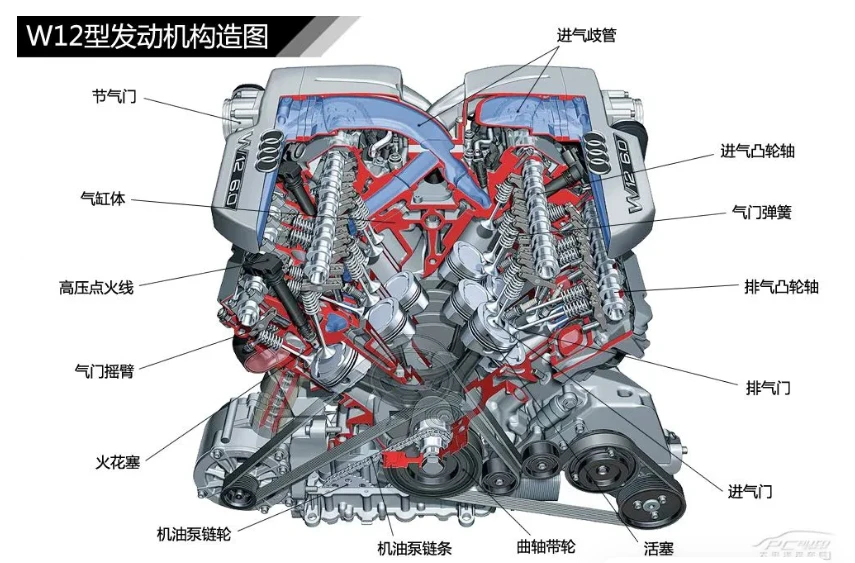
V. W-Engine: The Ultimate Heart of Flagship Luxury Cars
The Volkswagen Group took things a step further by combining two VR6 engines into a V-configuration to create the W-engine.
The W16 engine in the Bugatti Chiron-with its four turbochargers and 1,500 horsepower-isn't just an engine; it's a work of art and the ultimate form of a gas guzzler. Stomp on the accelerator, and you can actually watch the fuel gauge drop.
Analysis of Engine Structure Types – Pacific Auto Network
The Audi A8 W12 sold for over two million RMB in China back in the day; its twelve cylinders were as quiet as an electric vehicle, yet a deep press of the pedal revealed what it meant to be pinned to your seat with effortless, silent power.
The Bentley Continental GT also uses a W12; its composed acceleration feels like a sleeping lion suddenly stretching-languid, yet terrifying.
Bugatti W16 Engine, W16 Engine Diagrams, V16 Engine – Dashangu Gallery
VI. Rotary Engine: A Romantic Swan Song for Enthusiasts
Finally, let's talk about the rotary engine-the soul of the Mazda RX-7.
There are no pistons, only a triangular rotor spinning in circles. It is compact and lightweight, revs past 10,000 RPM, and produces a mesmerizing, bee-like buzzing sound. That yellow RX-7 from Jay Chou's movie *Initial D*-every time it appeared on screen, it was accompanied by a high-pitched, screaming wail from the engine that sent shivers down your spine.
How does a rotary engine work? Why didn't it achieve widespread adoption? – Zhihu
The Rotary Engine
A 1.3-liter twin-rotor engine could churn out 280 horsepower, yet the entire unit weighed a mere 81 kilograms.
However, the fuel consumption was absurdly high-ranging from 12 to 14 liters per 100 kilometers in city driving. The apex seals would suffer severe wear after just 50,000 to 100,000 kilometers, necessitating a major overhaul after relatively short mileage. There's a running joke online that Mazda rotary owners always keep a jug of engine oil in the trunk; while it's an exaggeration, it highlights the fact that rotary engines are indeed high-maintenance and demanding.
Romantic as the concept may be, it ultimately couldn't withstand the harsh realities of the market. Production officially ceased in 2002. The rotary-powered cars you see on the road today are mostly kept running through the sheer dedication of passionate enthusiasts.
On that note, let me ask you a question:
Of these six types, which one would you most like to own? Is it the inline-six, with its bone-deep smoothness? The V8, capable of delivering a thrill so intense it feels like an orgasm with a single rev? Or perhaps that rotary engine-the one you love and hate in equal measure?


