


This research focuses on optimizing the automatic clamping and online inspection processes in the precision machining of complex curved surfaces. A stable support for the part is achieved by designing a base plate forming punch, and real-time surface inspection is completed using side-head measurement technology, thus constructing a closed-loop control system for machining accuracy. Comparative analysis results show that the optimized automatic clamping and online inspection combination can reduce the local deformation of the part from 0.15mm to 0.05mm, improve machining accuracy by approximately 66%, and achieve a key point detection coverage rate of over 95%. The proposed collaborative optimization strategy provides quantifiable process basis and practical methods for machining complex curved surface parts, and has high application and promotion value.
01
Introduction
This research focuses on optimizing the automatic clamping and online inspection processes in the precision machining of complex curved surfaces. A stable support for the part is achieved by designing a base plate forming punch, and real-time surface inspection is completed using side-head measurement technology, thus constructing a closed-loop control system for machining accuracy. Comparative analysis results show that the optimized automatic clamping and online inspection combination can reduce the local deformation of the part from 0.15mm to 0.05mm, improve machining accuracy by approximately 66%, and achieve a key point detection coverage rate of over 95%. The collaborative optimization strategy proposed in this study provides quantifiable process basis and practical methods for machining complex curved surface parts, and has high application and promotion value.
02
Automatic clamping process optimization for precision machining of complex curved surfaces
2.1 Design principles of automatic clamping system
In the machining process of complex curved surface parts, clamping force, fixture rigidity and positioning accuracy directly affect the degree of deformation and machining quality of the parts. Reasonable clamping force needs to take into account both the machining stability and stress control of the parts, ensuring that the parts do not shift during the cutting process, and avoiding deformation caused by local stress concentration. The higher the rigidity of the fixture, the better the shape retention of the parts under the action of cutting force, and the higher the matching degree with the positioning accuracy of the machining center, thus ensuring the consistency and dimensional accuracy when repeatedly machining complex curved surfaces. The automated clamping system achieves rapid positioning and adjustable clamping force through a robotic arm or electric actuator, and can dynamically adjust the clamping state according to the shape characteristics of the parts and the machining stage, improving production efficiency while improving machining stability, which is the core technical means for precision machining of complex curved surfaces [1]. 2.2 Design and Optimization of Base Plate Forming Punch
The base plate forming punch plays a dual role in supporting and positioning complex curved surface machining. Its structural type and design rationality directly determine the clamping stability and part machining accuracy (see Figure 1). Punch design needs to comprehensively consider stiffness, bearing area, and contact distribution uniformity. A reasonable punch structure can effectively suppress warping deformation and local distortion of the part during machining. By analyzing the influence of different punch schemes on part deformation and clamping force distribution, the direction of punch structure optimization can be clarified, such as increasing the number of punch support points and adjusting the contact interface shape, to achieve minimum part deformation and force balance. This design optimization not only improves the controllability of the machining process but also provides a stable measurement benchmark for subsequent online inspection, laying the foundation for integrated machining and inspection.
Figure 1: Schematic diagram of base plate forming punch
2.3 Clamping Process Optimization Strategy
Traditional clamping methods often rely on fixed fixtures or manual adjustment, which are difficult to adapt to the varying support requirements of complex curved surface parts, easily leading to local deformation and accumulation of machining errors. In comparison, automated clamping technology achieves stable support throughout the entire part machining process through the coordinated optimization of clamping force parameters, fixture rigidity, and base plate punch structure. The optimized automated clamping scheme can balance the clamping force distribution, reduce part warping deformation, and significantly improve machining accuracy and repeatability. Simultaneously, through clamping strategy optimization, the optimal clamping parameters corresponding to different part shape characteristics and machining stages can be clearly identified, providing a scientific basis for the controllability of the machining process and enhancing the process reliability of precision machining of complex curved surfaces.
03
Integrated Online Inspection and Machining Process Analysis
3.1 Design Principles of Online Inspection System
Probe measurement is the core technology for achieving high-precision online inspection in the precision machining of complex curved surfaces. The probe (see Figure 2) scans the part surface through lateral contact or non-contact methods to complete the real-time acquisition of surface contour data. The probe layout design must fully consider the part geometry, machining space constraints, and clamping state to ensure that the probe can fully cover the key machining areas while avoiding interference with machining tools and fixtures. A reasonable probe layout can provide stable and continuous measurement data, providing a reliable basis for dynamic control of machining quality. Figure 2 Online inspection probe Different inspection methods have their own advantages in processing applications. Contact probes have high measurement accuracy, but the measurement speed is limited, and they are prone to local force effects on thin-walled or flexible parts. Non-contact methods such as laser scanning and optical scanning have fast measurement speed and strong adaptability, but they are greatly affected by the surface reflection characteristics and optical noise of the parts. The data acquisition system needs to integrate real-time processing algorithms to convert the original measurement data into geometric deviation information, and dynamically adjust the processing parameters through feedback logic to realize closed-loop control of processing and inspection, thereby improving the processing accuracy and reliability of complex curved surfaces[2]. 3.2 Processing-inspection integrated strategy Online inspection can monitor the geometric state of the parts in real time during the processing, detect processing deviations in a timely manner and guide the adjustment of processing parameters, significantly improving the processing accuracy of complex curved surfaces. The probe layout needs to be combined with the clamping position and the curvature distribution characteristics of the parts, focusing on covering high error sensitive areas. Studies have shown that a reasonable probe layout can minimize the detection blind zone, improve the accuracy of surface deviation acquisition, provide accurate basis for processing error compensation, and thus realize dynamic coordination between processing and inspection. Machining without online inspection cannot detect machining deviations in a timely manner, and manual correction results in low accuracy. While offline inspection can achieve error calibration, it suffers from significant time lag, easily leading to error accumulation. Online inspection, through real-time feedback forming a closed-loop control, can dynamically adjust the cutting path or clamping state, not only reducing machining error accumulation but also improving production efficiency and part consistency, providing solid theoretical support and process optimization basis for precision machining of complex curved surfaces.
3.3 Process Optimization Analysis
By comparing and analyzing key indicators such as surface deviation, machining stability, and feedback efficiency, the optimization direction for online inspection layout and acquisition accuracy can be clarified. Reasonable probe placement can ensure effective coverage of key curved surface points, reduce local errors, and avoid interference with fixtures and punches. Data processing algorithms can generate deviation mapping maps based on real-time acquired data, assisting in adjusting clamping force or cutting parameters to achieve a synergistic improvement in machining stability and surface quality.
Synergistic optimization analysis shows that probe arrangement and clamping system must work closely together to ensure consistent clamping stiffness and measurement accuracy. Through system analysis, online detection schemes adapted to different curvature characteristics and part shapes can be formulated, further improving the controllability of processing and the accuracy of curved surfaces. Overall process optimization emphasizes data acquisition accuracy, feedback response speed and clamping state coordination, and builds a complete theoretical framework for automated control and process optimization for precision machining of complex curved surfaces.
04
Automatic clamping and online detection collaborative optimization
4.1 Collaborative optimization idea
In precision machining of complex curved surfaces, the support effect of the base plate punch is closely related to the rationality of the probe layout [3]. Research data shows that when the punch support points are unevenly distributed or the rigidity is insufficient, the part will produce a maximum warping deformation of 0.15~0.20mm under the cutting force. Placing the probe in the high-risk warping area can effectively monitor deviation changes and achieve processing compensation. The core of the collaborative optimization idea is to achieve the matching and adaptation of clamping rigidity, part deformation and detection accuracy. Through the optimization of punch support layout and the design of probe key point coverage, the processing stability and measurement accuracy can be improved simultaneously [4]. Simulation analysis and design deduction revealed that higher clamping stiffness results in smaller part deformation, while the probe layout allows for focused monitoring of areas with significant curvature variations. For example, for complex curved surfaces with curvature radii of 50–120 mm, optimized punch structure can control local deformation to within 0.05 mm. Combined with real-time probe deviation acquisition and feedback to the machining control system, closed-loop precision management is achieved. This collaborative solution provides quantifiable process optimization criteria for complex surface machining, ensuring effective coordination between clamping and inspection functions.
4.2 Optimization Comparison Analysis
Table 1 compares the optimization effects of different process combination schemes. Table 1 shows that the traditional fixed clamping + offline inspection scheme has a deviation of up to 0.18 mm in high curvature areas, with generally poor machining stability; the automatic clamping + offline inspection scheme reduces the deviation to 0.10 mm, improving machining stability; the combination of base plate punch + automatic clamping + online inspection further reduces the deviation to 0.03–0.05 mm, significantly improving machining stability. Data shows that optimized punch support can reduce local warping deformation by approximately 60%, and online probe inspection can achieve over 95% coverage of key points, resulting in a dual improvement in machining accuracy and production efficiency.
Table 1: Optimization Effects of Different Process Combinations
Comprehensive analysis indicates that punch structure design, clamping force distribution, and probe layout require overall planning. The optimized combination scheme can control part deformation within allowable tolerances while ensuring real-time monitoring and dynamic adjustment of cutting parameters for surface deviations. This scheme not only improves the reliability of complex surface machining but also provides feasible process guidance for automated production of high-precision molds, aerospace, and automotive parts.
4.3 Process Implementation Recommendations
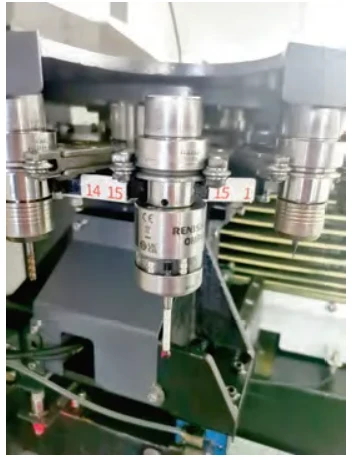
In precision machining of complex surfaces, the overall design of the clamping system and online inspection should follow the core principles of "rigidity priority, key point coverage, and feedback closed loop." The base plate punch design needs to consider both support rigidity and contact uniformity, and the probe layout should focus on covering key areas with large curvature changes and error sensitivity, achieving real-time monitoring and dynamic adjustment of the machining process. The optimization scheme can reduce the local deformation of the part from 0.15mm to within 0.05mm, and improve the machining accuracy by about 66%, providing a clear quantitative basis for process implementation [5]. The application practice shows that this collaborative optimization method is applicable to the machining of various types of complex curved surface parts, without the need for repeated process verification for a single part. Through the modular design of the clamping module and the probe arrangement, the integrated automated control of machining and inspection can be realized, and it can be flexibly adjusted to adapt to different specifications of parts and machining process requirements. Combined with the digital process model, this scheme can be applied to smart factories or digital twin production environments in the future, providing a replicable and scalable process framework, implementation guidelines and optimization decision reference for high-precision part machining. 05 Conclusion This paper systematically optimizes the automatic clamping and online inspection process in the precision machining of complex curved surfaces. The stability of part clamping is ensured by the design of the base plate forming punch, and the real-time monitoring and deviation compensation of key curved surfaces are realized by the probe measurement technology. The collaborative optimization results show that this combined scheme can significantly reduce the warping deformation and machining deviation of parts, and effectively improve machining stability and repeatability. This optimization scheme is highly adaptable and can be widely applied to the machining of various types of complex curved surface parts, providing replicable and scalable process guidance and practical basis for the machining of high-precision parts.


