


For many long-time car owners, the term "three-way catalytic converter" is certainly familiar.
Failing the annual emissions test, a sluggish engine response when accelerating, a stealthy rise in fuel consumption, or a sudden check-engine light-often, the same "culprit" lies behind these issues. There is an even more frustrating scenario: waking up to find that this metal canister under your car has been stolen.
Decoding Automotive Exhaust Secrets: The Mysteries and Real-World Challenges of the Three-Way Catalytic Converter (Yiche)
This metal canister, tucked away on the exhaust pipe, is both the make-or-break component for passing annual inspections and one of the most valuable parts of the vehicle-and it is the subject of many common scams and pitfalls.
I. What exactly is a three-way catalytic converter? What are the "three elements"?
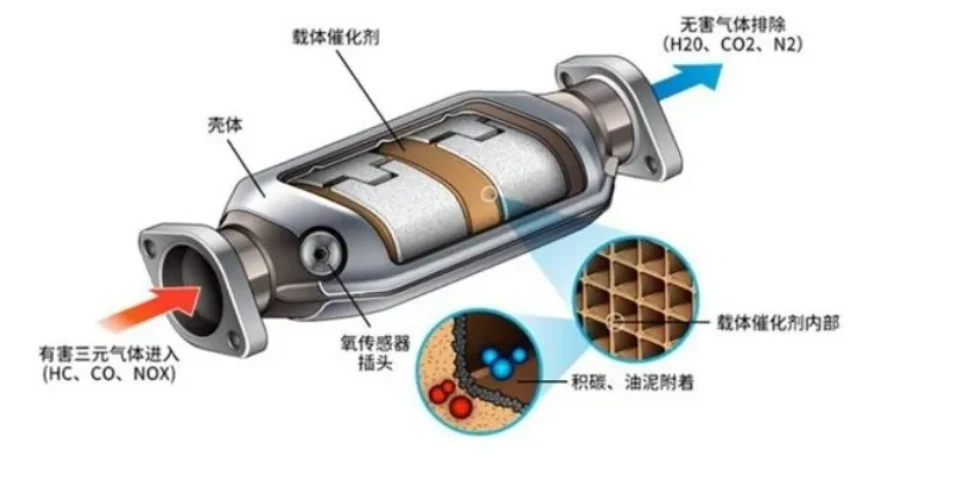
The three-way catalytic converter is installed between the exhaust manifold and the muffler; it looks somewhat like a stainless-steel vacuum flask. Its job is to process the exhaust gases emitted by the engine.
[Image]
The "three elements" in its name refer to three precious metals: platinum, palladium, and rhodium.
Exhaust gas exits the engine at high temperatures and passes through a honeycomb-like ceramic substrate inside the converter. The surface of this substrate is coated with those three precious metals, which act as catalysts to convert three types of harmful exhaust gases into harmless substances:
Carbon monoxide → Carbon dioxide
Hydrocarbons (unburnt gasoline) → Carbon dioxide + Water
Nitrogen oxides → Nitrogen + Oxygen
Under normal operating conditions, it can purify over 90% of harmful substances.
Simply put, it acts as a high-temperature air purifier for the exhaust system.
However, this component is sensitive to both cold and heat. Its optimal operating temperature range is 400°C to 800°C. During a cold start, the temperature is insufficient, resulting in low purification efficiency-which explains why exhaust fumes smell pungent right after starting the car in the morning. If the temperature consistently exceeds 1000°C, the internal ceramic substrate can melt or shatter, rendering the unit completely useless.
A quick note: Three-way catalytic converters are used only in gasoline vehicles. Diesel vehicles use a DPF (Diesel Particulate Filter); the structure and operating principles are different, so don't confuse the two. II. Five Signs of a Failing Three-Way Catalytic Converter
If your car exhibits two or more of the following symptoms, it is recommended to have it inspected as soon as possible:
1. Sluggish acceleration and struggling on hills
If the internal structure of the catalytic converter is clogged, exhaust gases cannot escape, creating "exhaust backpressure." When you press the accelerator hard, the engine RPMs shoot up, but the vehicle speed doesn't increase-it feels as if someone has stuffed a potato into the tailpipe.
2. Unexplained increase in fuel consumption
Restricted exhaust flow reduces engine combustion efficiency, forcing the car's computer to inject more fuel to maintain power. A tank of gas that used to cover 600 km might now only last for 500 km.
3. Check Engine Light on with fault code P0420 or P0430
These fault codes indicate "Catalyst System Efficiency Below Threshold."
⚠️ A common pitfall: Reading this code does not necessarily mean the catalytic converter is broken!
Aging or carbon-fouled upstream and downstream oxygen sensors can trigger the exact same fault codes. Don't let yourself be talked into immediately replacing the catalytic converter; investigate the issue thoroughly first.
4. Unusual exhaust odor and failure to pass annual inspections
Exhaust from a healthy car is virtually odorless. When the catalytic converter fails, a strong smell of gasoline or rotten eggs emanates from the rear of the vehicle. During emissions testing, pollutant levels will inevitably exceed legal limits.
5. Rattling noise from the undercarriage
The internal ceramic honeycomb substrate has shattered; when the car hits bumps or accelerates rapidly, you can hear the sound of broken fragments rattling against each other.
Image
III. Two types of clogs-one can be cleaned, the other cannot; don't waste your money
Type 1: Mild clogging due to surface carbon buildup (Salvageable)
Caused by frequent short-distance city driving, prolonged idling, or using low-quality fuel, resulting in carbon deposits coating the surface of the honeycomb pores.
Symptoms: Slightly reduced power; the Check Engine Light is not yet illuminated.
Solution: Professional removal, soaking, and cleaning yield the best results. For mild buildup, regularly driving at highway speeds can help clear away the carbon deposits using the high-temperature exhaust flow. Type 2: Irreversible Damage (Cleaning is futile; replacement is the only option)
Precious metal poisoning: If the engine burns oil, the phosphorus and zinc in the oil coat the precious metal layer, rendering it permanently ineffective.
High-temperature meltdown: Engine misfires (cylinder failure) or ignition issues allow unburnt fuel to enter the catalytic converter and combust; the internal substrate melts and causes a blockage.
Impact damage: Striking the undercarriage on potholes or obstacles can shatter the honeycomb substrate.
Key takeaway: If the substrate is shattered or the precious metals are poisoned, cleaning won't help-don't waste money on cleaning services.
IV. Follow these daily tips to extend the lifespan of your catalytic converter by years
Refuel at reputable stations; don't risk using cheap fuel from unknown sources.
Address issues like oil burning, engine misfires, or rough idling immediately; don't delay repairs.
Avoid frequent short-distance trips with a cold engine, as these conditions are most likely to cause carbon buildup.
Slow down over potholes or uneven roads to avoid striking the undercarriage.
V. Industry Trivia: Why do people steal these?
You may have heard news reports about catalytic converters being stolen-this isn't an urban legend; it really happens.
The reason is simple: the three precious metals inside are extremely valuable.
As of 2026, rhodium sells for around 5,000 yuan per gram, platinum for 230 yuan/gram, and palladium for 380 yuan/gram. The scrap value of an OEM catalytic converter from an ordinary family car easily exceeds 3,000 yuan; for luxury brands or hybrid models, the value of a single unit can soar to between 10,000 and 30,000 yuan.
Values vary significantly between vehicle models. A 10-year-old Japanese Toyota Camry or German Audi might have a catalytic converter worth 800 to 1,500 yuan, whereas a Ford Focus or Buick Excelle (American brands) of the same age is often worth only 300 to 500 yuan. 90% of the value depends on the precious metal content inside.
How can you tell if your car's catalytic converter has been stolen? - Zhihu
This is why some people crawl under cars in the middle of the night to steal this part: they swap in a cheap aftermarket replacement and resell the original for thousands-or even tens of thousands. You might notice a drop in power, increased fuel consumption, or a failed annual inspection while driving; only upon investigation do you realize your car's "kidney" has been harvested.


