If you follow the automotive world closely, you might have noticed an interesting pattern: German cars generally use dual-clutch transmissions (DCTs), American cars favor automatic transmissions (ATs), while Japanese cars-especially high-volume family models-almost exclusively use continuously variable transmissions (CVTs).
[Image]
One might ask: Doesn't Japan have Aisin? Aisin's automatic transmissions are world-renowned, and Toyota is a major shareholder in Aisin. So why don't they use their own ATs instead of relying so heavily on CVTs?
Behind this question lies the entire manufacturing philosophy of Japanese automakers.
**First, let's understand what a CVT actually is.**
Before discussing the "why," we need to clarify what a CVT is.
CVT stands for Continuously Variable Transmission. Traditional ATs rely on sets of gears to shift; for instance, a 6AT has six forward gears, and an 8AT has eight. Each gear corresponds to a fixed gear ratio, and shifting involves switching from one gear to another.
[Image: In-depth analysis of CVT transmissions]
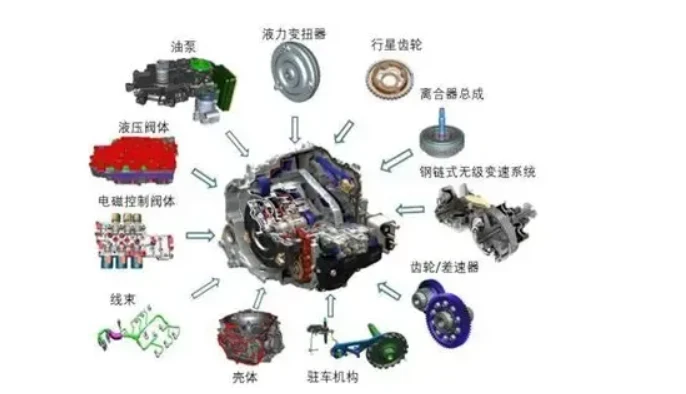
A CVT is completely different. It has no concept of discrete "gears." Its core structure consists of just three components: two conical pulleys and a steel belt.
You can visualize the mechanism of a multi-speed bicycle. Both the driving and driven pulleys are conical discs with variable diameters, connected by a steel belt. A hydraulic system pushes the conical discs to move closer together or further apart, causing the belt's working radius to change continuously-a larger radius acts like a "large gear," while a smaller radius acts like a "small gear."
[Image]
The key lies in the word "continuously." While ATs shift in discrete steps, a CVT can transition smoothly and seamlessly between the maximum and minimum gear ratios, theoretically providing an infinite number of gear ratios.
This results in several distinct characteristics of CVTs.
**Advantage 1: Fuel Efficiency**
This is the factor Japanese automakers prioritize above all else.
A CVT allows the engine to operate consistently within its most efficient RPM range. In contrast, when an AT shifts gears, the engine speed rises and falls, creating ranges where energy is "wasted." CVTs can adjust the gear ratio in real-time based on vehicle speed and throttle input, keeping the engine speed locked precisely at its most fuel-efficient point.
[Image]
Advantage 2: Smoothness
Anyone who has driven a car with a CVT knows the feeling of seamless acceleration-something difficult for AT (Automatic Transmission) and DCT (Dual-Clutch Transmission) systems to replicate. ATs often experience a slight interruption in power or a jolt during gear shifts, while DCTs can be prone to jerkiness at low speeds. In contrast, the CVT's acceleration follows a smooth curve, delivering continuous, uninterrupted power.
This smoothness translates into noticeable comfort, especially in stop-and-go city traffic.
Advantage 3: Low Cost and Compact Size
The structure of a CVT is far simpler than that of an AT. An AT contains complex planetary gear sets, multiple clutch packs, and brake bands, whereas a CVT primarily consists of two variable-diameter pulleys and a steel belt.
The number of components is about 20% lower than that of a 6-speed AT. They are also significantly lighter-Aisin's famous transverse 6-speed AT weighs 90 kg, while a comparable CVT weighs only 67.5 kg, a difference of 22.5 kg.
With fewer parts and lower weight, costs naturally decrease. For automakers producing vehicles on a massive scale, saving even a small amount per transmission-multiplied by sales volumes in the millions-results in a huge profit margin.
So, the question arises: are other automakers unaware of these advantages?
They certainly are aware. However, there are deeper reasons why Japanese automakers favor CVTs.
Japan's National Circumstances Make Fuel Efficiency a Survival Imperative
Japan is a resource-poor nation that relies almost entirely on imported oil. For Japanese automakers, fuel efficiency is not merely a "selling point"-it is a fundamental requirement for survival.
[Image: High-definition photo of congested city traffic]
Furthermore, Japan's domestic roads are narrow and crowded, and speed limits are low (100 km/h on expressways); most driving consists of city commuting and low-to-medium speed travel. Under these conditions, the CVT's strengths-fuel efficiency and smoothness-are maximized, while its weaknesses (such as sluggish response during rapid acceleration and a lack of power for high-speed overtaking) are barely noticeable in daily use. Japanese car manufacturing philosophy aligns perfectly with CVT technology.
The core selling points of Japanese family cars have never been "performance" or "handling," but rather "durability, fuel efficiency, and ease of driving."
The smoothness of a CVT ensures comfort for both the driver and passengers; its fuel efficiency relieves the burden of ownership costs; and its simple structure means fewer potential points of failure.
More importantly, the naturally aspirated engines that Japanese family cars favor are a perfect match for CVTs. Naturally aspirated engines deliver power linearly, avoiding the sudden surges of torque characteristic of turbocharged engines. When the continuous gear-ratio changes of a CVT combine with the linear output of a naturally aspirated engine, the driving experience is incredibly smooth and responsive to throttle inputs.
So, why don't German cars use CVTs?
This comes down to two completely different approaches to vehicle design.
German cars-particularly those from Volkswagen, BMW, and Audi-emphasize performance and driving pleasure. Many of their engines are turbocharged, delivering high torque and explosive power. CVTs, however, rely on friction between a steel belt and conical pulleys to transmit power, which inherently limits the amount of torque they can handle. During hard acceleration, the car's computer limits torque output to prevent the belt from slipping, resulting in a sensation where the engine revs loudly but the car doesn't pick up speed accordingly.
Which is better: Japanese cars or German cars? A look at the global market tells the story!
Furthermore, the "shift shock"-that crisp, forceful rhythm of gear changes-sought after in German cars is something a CVT cannot provide. CVTs are so smooth that enthusiasts seeking a dynamic driving experience often find them "boring."
Consequently, German manufacturers opt for dual-clutch transmissions (DCTs) and traditional automatic transmissions (ATs); these can handle higher torque, shift faster, and offer a more engaging "feel."
Not all Japanese cars use CVTs, however.
It is worth noting that the use of CVTs in Japanese cars is primarily concentrated in economical family models.
For models with larger displacement engines or those focused on performance, manufacturers still utilize traditional automatic transmissions (ATs). For instance, the Toyota Camry 2.5L uses an 8-speed AT, the Honda Avancier 2.0T uses a 9-speed AT, and the Nissan Patrol uses a 7-speed AT. CVT technology has been continuously evolving over the years.
Many people still associate CVTs with issues like slipping, sluggishness, and poor durability. In reality, Japanese automakers have invested heavily in improving CVT technology.
Toyota incorporated a launch gear into its CVT system; by using gear transmission at low speeds, it resolved the issue of sluggish acceleration when starting off.
Honda developed "G-Design Shift" control technology, optimizing transmission efficiency and throttle response. A Civic equipped with a 1.5T engine and CVT can accelerate from 0 to 100 km/h in under eight seconds.
JATCO, a company controlled by Nissan, is the world's largest CVT manufacturer. Its latest CVT8 transmission utilizes a high-strength steel belt (rated at 490 MPa) capable of handling 380 Nm of torque, making it compatible even with 3.5L V6 engines.
Of course, no matter how much the technology advances, CVTs still have inherent physical limitations. They remain the ideal transmission type for family use, yet the least suitable for aggressive driving.
So, returning to the original question: why do most Japanese automatic cars use CVTs?
The answer is simple: most consumers are looking for a car that is fuel-efficient, smooth, easy to drive, and affordable.
Japanese automakers simply met the genuine needs of the majority at the right time using the right technology.
As for those who prioritize performance-they can simply opt for vehicles with traditional automatic transmissions (AT) or dual-clutch transmissions (DCT). There is no such thing as a perfect transmission; there is only the one that best suits your needs.