


Did you know? When we look at photos of airplanes, the first things that catch our eye might be the livery or the wings. However, the true determinants of an aircraft's speed, range, and passenger capacity lie in the "heart" hidden beneath the wings or inside the fuselage: the engine.
Turbojet, turbofan, turboprop, and turboshaft-these four names might sound like a tongue twister when listed together. Yet, once you grasp the relationships between them, the fundamental logic behind aircraft design becomes instantly clear. Let's break it down today.
[Image]
First, keep this core concept in mind: these four types of engines belong to the same family. They all operate based on the gas turbine principle. Simply put: air is drawn in → compressed → fuel is injected and burned → high-temperature, high-pressure gas drives the turbine to spin → exhaust is expelled to generate thrust. All four share this exact same core process.
The difference lies in how they channel the power generated after combustion.
1
Turbojet Engine: The Original Lineage
The full name is "turbojet engine," and it was the first type of jet engine to reach maturity. Its operating principle is the most straightforward: all the air follows a single path-compression, combustion, and expulsion. The faster the exhaust is expelled, the greater the thrust.
In combat, the moment a pilot engages the afterburner, thrust can surge by 30% to 100%; however, this capability can only be used briefly, as fuel consumption is astronomically high.
The turbojet's greatest advantage is speed, making it ideal for high-altitude, high-speed flight. Its biggest drawback is high fuel consumption; efficiency is particularly poor during low-speed flight.
[Image: Schematic diagram of turbojet engine structure]
Has anyone ever wondered if it might be possible to add an extra layer of air around the engine-air that bypasses the combustion chamber and is simply pushed out by a fan to generate thrust? Wouldn't that save fuel?
And so, the turbofan engine was born.
2
Turbofan Engine: The Reigning Champion
You can think of a turbofan engine as a turbojet engine wearing an "air coat." A large fan is installed in front of the original core engine. Once the air enters, it splits into two paths:
A small portion follows the central "old path" (inner duct/core): compression → combustion → exhaust → thrust generation.
A large portion follows the outer "new path" (outer duct/bypass duct): accelerated only by the fan → direct exhaust → thrust generation (and greater fuel efficiency).
[Image]
Operating principles of turbofan engine inner and outer ducts (core and bypass flows)
The key lies in a single figure: the **bypass ratio**. This is a core concept in aero-engines. Simply put, it is the ratio of the mass of air flowing through the outer duct to the mass of air flowing through the inner duct.
Bypass ratio of zero → Turbojet engine
Low bypass ratio (e.g., 0.2–0.3) → Good high-speed performance → Used on fighter jets
High bypass ratio (e.g., 8–9 or higher) → Highly fuel-efficient, low noise → Used on civil airliners
The world's largest civil turbofan engines today achieve bypass ratios exceeding 10. In other words, the air generating thrust through combustion in the engine core accounts for less than one-tenth of the total; the remaining 90% of the thrust comes from the air pushed by the massive fan. This is the secret behind their combination of power and fuel efficiency.
[Image]
3
Turboprop Engine: The "Hercules" of Aerial Transport
Many people mistake turboprop engines for old-fashioned piston engines. In reality, they are completely different. At its core, a turboprop engine is essentially a jet engine, but it transmits most of the power generated by the turbine to an external propeller via a reduction gearbox.
The pulling force (thrust) generated by the propeller churning the air is the primary source of propulsion, while the weak exhaust stream from the tailpipe plays only an auxiliary role. In essence, if you took a turbofan engine, exposed its large fan to the outside, and reduced its rotational speed, you would essentially have a turboprop engine.
[Image]
Turboprop engine
The advantage of the turboprop is its extremely high efficiency during low-speed flight-it is even more fuel-efficient than the turbofan. At flight speeds below 600 km/h, the turboprop engine holds an overwhelming advantage.
Its disadvantages are also obvious: it cannot fly very fast and generates significant noise. The Russian Tu-95 bomber, which uses turboprop engines, is famously nicknamed the "Bear." When a propeller spins at high speed, its tips break the sound barrier, generating an incredibly loud noise-reportedly audible from up to 20 kilometers away. High speed combined with deafening noise is simply one side of the turboprop coin.
Image
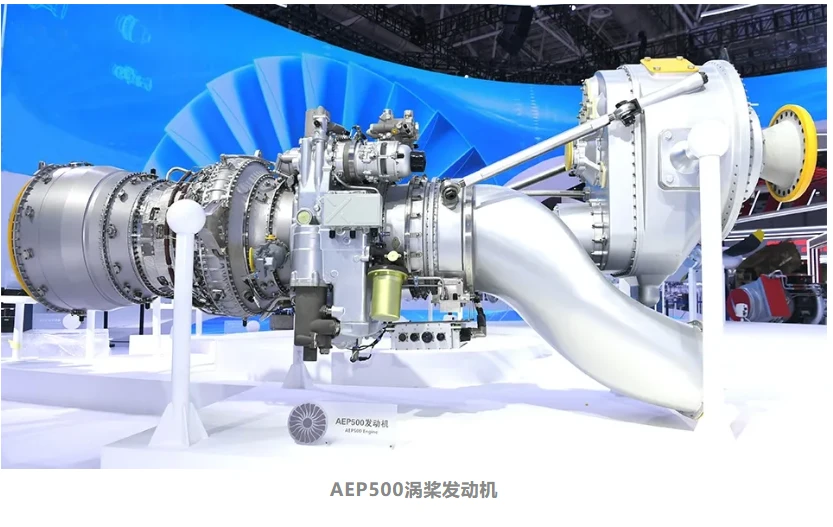
AEP500 turboprop engine
Turboprops are particularly well-suited for low-to-medium-speed transport aircraft, patrol planes, and regional airliners. They do not require high speeds but prioritize fuel efficiency, low costs, and minimal runway requirements. Many turboprop aircraft can take off from and land on short, unpaved strips-a feat impossible for standard commercial airliners.
4
Turboshaft engines: Built specifically for helicopters
Having covered turboprops, turboshafts are easy to understand. While a turboprop directs its power to spin a propeller, a turboshaft directs it to spin a helicopter's rotor.
Image
Turboshaft engine
Turboshaft engines possess several key characteristics:
Extremely high power-to-weight ratio-they are compact and lightweight yet deliver immense power. This is crucial for helicopters; every kilogram of weight saved allows for an extra kilogram of payload.
Compact structure-designed to fit within the narrow fuselage of a helicopter.
Adjustable exhaust direction-unlike other engines that must exhaust rearward, the exhaust path can be tailored to the helicopter's specific airframe layout.
Turboprops and turboshafts are essentially two variants of the same core engine. Manufacturers simply need to modify the final output mechanism; the same core engine can serve as a turboprop for fixed-wing aircraft or a turboshaft for helicopters. The aviation industry was practicing this kind of modular design long before the concept became a trend.
Finally, let's clarify the relationships between the four types:
Turbojet: The ancestor; the purest form. It offers the highest speeds but consumes the most fuel.
Turbofan: The improved version. It adds a large fan to balance thrust and fuel efficiency, making it the current industry standard.
Turboprop: The fuel-efficient version. It directs all power to the propeller, offering excellent economy at lower speeds.
Turboshaft: The specialized version. It converts power into shaft output specifically to drive helicopter rotors. None of the four engine types is inherently superior to the others; each has its own arena and its own way of thriving.


