


On July 3, Galactic Energy dropped a bombshell: the cumulative test-firing time of its self-developed reusable "Cangqiong-50" engine officially surpassed 20,088 seconds.
What does this figure signify? It means the engine has endured over five hours of rigorous ground testing-a grueling process of repeated operation. Its design goal is to withstand at least 25 reuses.
First flight coming soon! Main engine of the Pallas-1 rocket logs 20,088 seconds of testing; capable of over 25 reuses.
Even more noteworthy is the official announcement that the Pallas-1 rocket-powered by this engine-is set for its maiden flight "in the near future." Note the phrasing: not merely "planned," but "in the near future."
With 2026 already halfway through, the race for reusable rockets in China's commercial space sector is finally seeing the arrival of a true contender.
What exactly is being validated by 20,088 seconds of testing?
Let's break down the significance of these figures.
To date, Galactic Energy has conducted a total of 57 ignition tests on complete Cangqiong-50 engine units. The longest continuous run for a single engine lasted 2,757 seconds.
It's not just about whether the engine can ignite. The biggest concerns for reusable engines are burning out after a single use or incurring repair costs that exceed the price of building a new one.
Key component of the "Cangqiong" engine: Pintle injector thrust chamber test unit assembled and delivered – Zhihu
The Cangqiong-50 utilizes a pintle injector design. Simply put, this ensures more uniform mixing of fuel and oxidizer, resulting in more stable combustion. Its advantages include inherent support for multiple ignitions and deep thrust modulation, allowing for smooth adjustments across a range of 32% to 105% of maximum thrust.
In plain language: precise thrust control is essential during rocket landing, and this engine delivers exactly that.
It boasts a thrust control precision of just 0.5%. What does this level of precision mean? It means that during a vertical landing, the rocket won't crash and shatter due to fluctuating thrust.
Manufacturing processes are evolving, too-3D printing has entered the picture.
Beyond performance, the manufacturing of the Cangqiong-50 is also a highlight. Officials have noted the extensive use of 3D printing and welding techniques for the thrust chamber. Traditional engine manufacturing involves casting, machining, and assembling numerous individual parts-a process that is both time-consuming and costly. In contrast, 3D printing allows complex structures to be "printed" in a single piece.
SLM (Selective Laser Melting)-a material system capable of multi-metal 3D printing: manufacturing potential, challenges, and key considerations.
The result is a 30% reduction in production time and a 15% drop in manufacturing costs.
Do not underestimate this 15% cost reduction. In the commercial space sector, cost equates to competitiveness; whoever can drive down launch prices secures more orders.
Furthermore, 3D printing offers a hidden advantage: the post-test inspection and maintenance process is vastly simplified, allowing for rapid re-inspection without disassembly. This is crucial for reusability-if an engine had to be completely taken apart for inspection after every flight, the cost of reuse would remain prohibitively high.
Ceres-1 (Zhishenxing-1): Seven engines in parallel-if one fails, six remain operational.
Having discussed the engines, let us look at the rocket itself.
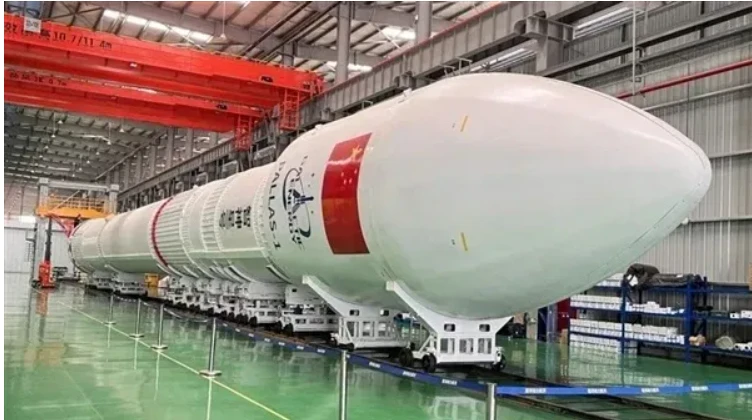
Ceres-1 is a medium-to-large reusable liquid-propellant launch vehicle featuring a two-stage configuration. The first stage (the bottom section of the rocket) utilizes seven "Cangqiong-50" engines arranged in parallel.
It has a liftoff mass of 283 tons, a liftoff thrust of 350 tons, and a payload capacity of 7 tons to Low Earth Orbit (LEO).
What does a 7-ton capacity mean in practical terms? It is sufficient for domestic LEO satellite constellation deployment, allowing multiple satellites to be launched in a single mission.
The key design highlight is the fault redundancy provided by the seven-engine parallel configuration. Xia Dongkun, Executive President of Galactic Energy, stated quite plainly in an interview: if a single engine malfunctions, the remaining six can still sustain the flight.
This represents a pioneering approach for reusable rockets in China.
Why this design? Because the greatest risk for a reusable rocket is an engine malfunction during landing. SpaceX's Falcon 9 employs a similar logic with its nine-engine parallel configuration-using redundancy to ensure mission safety. "Ceres-1" (Zhishenxing-1), a medium-to-large liquid-propellant launch vehicle developed by the domestic commercial space company Galactic Energy, rolled off the assembly line on May 17.
**No recovery attempt on the maiden flight, but a four-step roadmap**
One detail worth noting is that the maiden flight of "Ceres-1" will not include recovery verification.
Galactic Energy has adopted a steady, step-by-step approach divided into four phases:
**Phase 1:** Baseline verification for the maiden flight. This involves achieving orbit and payload delivery, capturing comprehensive flight data, and verifying baseline capabilities for overall propulsion and control. Simply put, the priority is ensuring the rocket can launch successfully and deliver its payload to the intended destination.
**Phase 2:** Over the course of the next two to three missions, the company will gradually activate first-stage re-entry control, grid fin operation, and braking/deceleration maneuvers, while verifying precision recovery at designated sea or land sites.
**Phase 3:** Following full verification of control, propulsion, and structural systems, the company aims to achieve complete vertical landing and recovery of the first stage. This will be followed by refurbishment, engine re-testing, and a second flight using the reused rocket body.
**Phase 4:** Transition to a stage of high-frequency reuse and commercialized reuse operations.
This pace is highly pragmatic. Rather than chasing the gimmick of "recovery on the maiden flight," the company prioritizes successful orbital insertion first, tackling the difficult challenges of recovery step by step.
**Maiden flight coming soon! "Ceres-1" main engine has logged 20,088 seconds of cumulative test-firing; designed for over 25 reuses.**
Xia Dongkun explains the situation clearly: "The development phase requires overcoming the complexities of propulsion balancing and control algorithms for a seven-engine cluster. During the orbital insertion phase, the core challenge is no longer merely a technical breakthrough, but ensuring system-wide operational compatibility and high-reliability insertion in a real flight environment to build market confidence. The recovery phase presents extreme technical tests, such as navigating complex aerodynamic environments during re-entry, high-precision guidance, and precise propulsion control."
Each of the three phases presents a unique set of challenges.
**Galactic Energy's trump card: The "Ceres-1" (Guxingxing-1) series has already completed 21 launches.**
Many people focus solely on "Ceres-1" (Zhishenxing-1) while overlooking Galactic Energy's other product line-the "Ceres-1" (Guxingxing-1) series. Ceres-1 is a solid-propellant rocket that has successfully completed 21 commercial launch missions, delivering 89 satellites into their intended orbits.
A maiden flight is coming soon! The main engine of the Pallas-1 rocket has accumulated 20,088 seconds of test-run time and is designed to be reusable more than 25 times.
What does this signify? It means Galactic Energy is the only private Chinese rocket company to have achieved a track record of continuous, stable launches.
We are not talking about "planned launches" or "preparations for launch"-we are talking about 21 actual launches already completed.
This is a unique achievement in the private commercial space sector. While most private rocket companies are still struggling to achieve their first successful orbital insertion, Galactic Energy has already validated its business model and accumulated engineering expertise and a client base through its solid-propellant rockets.
Xia Dongkun made a crucial point: "Through the practical experience of 21 successful commercial launches-deploying 89 satellites for 27 clients-the Ceres series has laid a dual foundation, both engineering and commercial, for the Pallas-1 rocket."
Using solid-propellant rockets to generate revenue and build experience while tackling core technologies for reusable liquid-propellant rockets-this "two-pronged" strategy ensures steady, solid progress.
[Image]
It's not just Pallas-1; Pallas-2 is also in the pipeline.
Galactic Energy's ambitions go even further.
Xia Dongkun revealed that Pallas-2 is scheduled for its maiden flight early next year. It is a large-scale, modular, reusable liquid-propellant launch vehicle with a Low Earth Orbit (LEO) payload capacity of 58 tons.
What does a 58-ton capacity mean? It means the company could potentially deploy an entire satellite internet constellation in a single go.
From Ceres-1 (300kg class) to Ceres-2 (1–2 ton class), and on to Pallas-1 (7-ton class) and Pallas-2 (58-ton class)-Galactic Energy has established a comprehensive product lineup spanning capacities from 300kg to 58 tons.
What does a full product spectrum mean? Whether a client needs to launch small or large satellites, or requires high launch frequency or massive payload capacity, Galactic Energy has a suitable product.
2026: The "Year of the Big Test" for reusable rockets
Let's broaden our perspective to look at the industry landscape as a whole.
Maiden flight coming soon! Ceres-1's Main Engine Logs 20,088 Seconds of Test Firing; Designed for Over 25 Reuses
Many regard 2026 as a "banner year" for reusable rockets in China's commercial space sector, with various private rocket companies racing to reach milestones:
LandSpace's Zhuque-3 completed its maiden orbital flight in December 2025, though the recovery of its first stage failed. Plans are in place to conduct another recovery test in the second quarter of this year, aiming for a flight that attempts both recovery and reuse by the fourth quarter.
Space Pioneer's Tianlong-3 achieved its first orbital flight on April 3 of this year, though it fell short of fully meeting its mission objectives.
i-Space's Hyperbola-3 is scheduled for its maiden flight between late 2025 and early 2026, with plans to attempt a sea-based recovery.
Deep Blue Aerospace's Nebula-1 is slated for a maiden flight around the Spring Festival, aiming to achieve recovery on its very first flight.
OrienSpace's Gravity-2 is scheduled to complete its maiden flight mid-year.
Add to this list Galactic Energy's Ceres-1, and it becomes clear that at least five or six reusable liquid-fueled rockets are set to make their mark in 2026.
However, the reality is sobering. Zhang Xiaodong, Chief Designer of LandSpace's Zhuque-3, candidly admitted at the 2026 Space Computing Industry Conference: "We have yet to successfully recover a reusable first-stage rocket; we are still a long way off from achieving rapid reuse."
A massive technological chasm separates the ability to fly from the ability to recover.
[Image]
Capital is also placing its bets: A valuation of 15 billion yuan and ongoing IPO preparations.
Behind the technological competition lies a battle of capital investment.
Galactic Energy has completed 10 rounds of financing, reaching a valuation of approximately 15 billion yuan. Its 2.4-billion-yuan Series D round, completed in September 2025, set a record for the largest single financing deal among domestic private rocket companies; the company has raised over 5.3 billion yuan in total.
In October 2025, Galactic Energy filed for IPO guidance, a mandatory pre-listing step in China. It is currently in the IPO guidance phase.
The "Five Dragons" of the commercial space sector are all racing ahead: LandSpace and CAS Space have reached the "inquiry" stage of their IPO reviews, while Space Pioneer, i-Space, and Galactic Energy are currently in the IPO guidance phase. Whoever goes public first secures more capital and gains a head start in the race.
However, going public is a double-edged sword. Galactic Energy suffered a launch failure with its Ceres-1 rocket in January of this year, and Space Pioneer's Tianlong-3 faced setbacks during its maiden flight-the capital market's tolerance for "trial and error" is limited.
Industry Shakeout: Not All Players Will Survive
By 2026, China's commercial space sector will reach a critical juncture, transitioning from "technology validation" to achieving a "closed-loop commercial model."
In simple terms: the competition used to be about "who could build a rocket," but now it is about "who can make money using rockets."
Reusability is the key to cost reduction. Whoever achieves rocket recovery and reuse first will be able to slash launch costs and secure a ticket to the "second half" of the commercial rocket race.
The reality, however, is that R&D investment is massive, and the cost of failure is high. CAS Space's projected R&D expenditure for 2025 is 504 million yuan-4.2 times that of 2023. Burning through this much capital does not guarantee a successful outcome.
An industry shakeout is already underway; not every player will survive long enough to see the day of profitability.
Galactic Energy holds a distinct advantage: its Ceres series has already generated significant revenue at scale. Cash flow from solid-fuel rockets is funding the R&D of liquid-fuel rockets-an advantage most other private rocket companies lack.
Closing Thoughts
The maiden flight of the Pallas-1 rocket represents more than just a launch.
It marks a pivotal leap for China's private commercial space sector, shifting from a reliance on solid-fuel rockets to the era of reusable liquid-fuel rockets. A 7-ton payload capacity, a seven-engine cluster design, and a target of 25 reuses-behind these figures lies the maturation of an entire engineering ecosystem.
Yet, one should not be overly optimistic. The maiden flight is merely the first step; recovery is the real battle. Xia Dongkun put it plainly: "The greatest challenge in the development, orbital insertion, and recovery of reusable rockets lies in bridging the capability gaps between these different stages."
From maiden flight to recovery, from recovery to reuse, and from reuse to commercialization-each step presents a formidable hurdle.
The story of China's reusable rockets is only just beginning in the second half of 2026. We shall wait and see who manages to survive and emerge from this round of industry reshuffling.


