


According to the latest auto sales rankings released by the CPCA (China Passenger Car Association), no internal combustion engine (ICE) vehicles made the top ten list in May; all were electric vehicles. The top ten models were the Geely Xingyuan, Model Y, Xiaomi SU7, Leapmotor A10, Li Auto i6, Sea Lion 06, Model 3, Hongguang MINI EV, AITO M6, and Tai 7. The Geely Xingyuan took the top spot with 38,751 units sold, while the Model 3 and AITO M6 saw significant surges in their sales rankings.
[Image]
Specifically, the Geely Xingyuan secured first place again with monthly sales of 38,751 units, making it the only model to surpass the 30,000-unit mark. The Xingyuan is a compact car from Geely Auto; a 2026 model-year refresh was launched on May 28 with a limited-time price range of 61,800 to 91,800 RMB. Enhanced product capabilities will support stable future sales; as a refreshed model, it features independent suspension, the G-TCS 2.0 all-weather anti-slip and anti-fishtail system, the ONEBOX integrated braking system, and the Flyme Auto 2.0 AI smart cockpit, alongside upgrades in five key areas: driving dynamics, the electric powertrain system, driver assistance, cockpit experience, and safety.
[Image]
The Model Y remained highly popular, ranking second with monthly sales of 28,911 units-surpassing the Xiaomi SU7. The Model 3 sold 18,370 units in May, ranking seventh and climbing significantly in the standings compared to April.
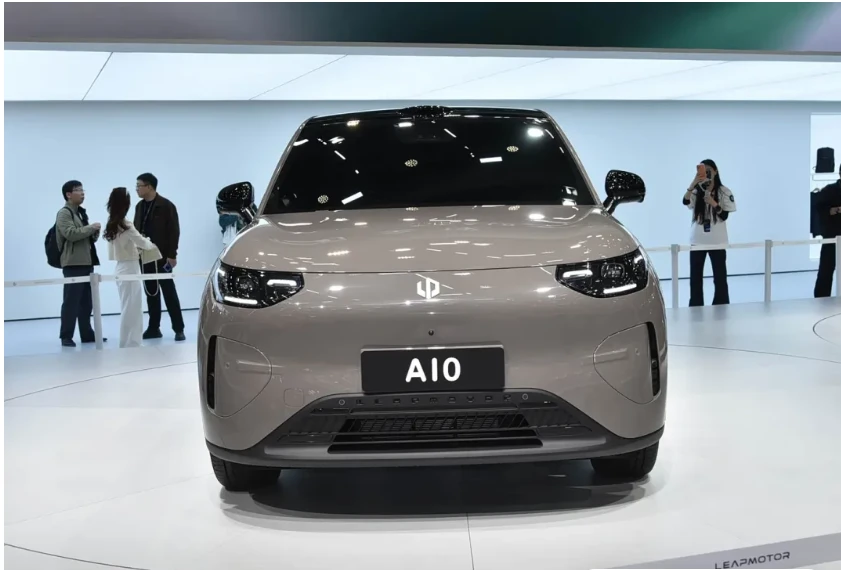
The Xiaomi SU7 ranked third with 24,023 units sold, down from 26,826 units in April. The SU7 officially launched on March 19 with a starting price of 219,900 RMB. According to data officially released by Xiaomi Auto on May 6, the model had accumulated over 80,000 confirmed orders. The Leapmotor A10 is another popular model in the top ten; officially launched on March 26 with a price range of 65,800–86,800 RMB, it recorded sales of 22,306 units in May-a significant increase from the 14,372 units sold in April-and has become one of Leapmotor's best-selling models. Positioned as a pure electric compact SUV, the A10 features LiDAR, Qualcomm 8295 and 8650 chips, and offers a maximum range of 505 km.
[Image]
Li Auto's Li i6 recorded sales of 22,306 units in May, ranking fifth domestically with stable sales figures hovering around the 20,000-unit mark. As the second pure electric SUV from Li Auto, the Li i6 is built on a dedicated pure electric architecture and features a five-seat layout. It offers CLTC pure electric ranges of 660 km, 710 km, and 720 km, and was launched in September 2025.
The AITO M6 officially launched on April 22 with a price range of 259,800–299,800 RMB, making May its first full month of sales. It is the best-selling model under the Harmony Intelligent Mobility Alliance (HIMA), with 18,148 units sold in May-the only model in its lineup to surpass the 10,000-unit sales mark. Positioned as a mid-to-large SUV with a five-seat layout, the M6 sits between the AITO M5 and M7. It comes standard with the Huawei Tuling platform and 896-line dual-beam image-grade LiDAR across the entire lineup, offering powertrain options that include both pure electric and extended-range systems.
[Image]
The Hongguang MINI EV ranked eighth with sales of 18,308 units. The all-new Hongguang MINI EV officially launched on March 27, priced between 44,800 and 54,800 RMB. Retaining its positioning as a micro pure electric vehicle, the new model features a four-door, four-seat layout, a completely revamped exterior and interior, and a maximum CLTC range of 301 km.
The Fang Cheng Bao Tai 7 ranked tenth with sales of 17,510 units. Since its debut in September 2025, the Fangchengbao Titanium 7 has rapidly become the brand's best-selling product. This success stems from its outstanding product capabilities and popular "boxy" styling, combined with a starting price of just 179,800 yuan-significantly lower than market expectations-which naturally sparked a market frenzy. On April 29, the Titanium 7 EV Flash Charge edition was launched with two variants priced at 199,800 yuan and 209,800 yuan, respectively. As a pure electric model, it features the second-generation Blade Battery and flash-charging technology, offering a maximum pure electric range of 755 km; its arrival further expands consumer choices.
[Image]
There are no internal combustion engine (ICE) vehicles in the top ten, and only three outside that range: the Boyue L (17th), Lavida (18th), and Sylphy (20th). Extending the list to the top 30 reveals significant sales gains for models like the Tiguan L, Magotan, Tayron, Xingyue L, Honda CR-V, and VW Passat, yet they still fail to match the momentum of new energy vehicles (NEVs).
Data from the CPCA (China Passenger Car Association) shows that retail sales of ICE passenger vehicles in May totaled 560,000 units-down 39% year-on-year but up 5% month-on-month. Meanwhile, retail sales of NEV passenger vehicles reached 950,000 units-down 7.5% year-on-year but up 12.4% month-on-month. NEVs achieved a domestic retail penetration rate of 62.9%, setting a new monthly record. Notably, no ICE vehicles appeared among the top 10 best-selling models in May, and only three made the top 20. Looking ahead, NEV sales are expected to remain high, while ICE vehicles will continue to face market pressure.
Cui Dongshu, Secretary-General of the CPCA, predicts that while ICE vehicles will not disappear entirely, their overall market scale will shrink drastically, eventually settling into a niche market pattern characterized by "high-end premium models" and "specialized utility vehicles." Furthermore, internal combustion engine vehicles may experience opportunities for a temporary, sporadic rebound; factors such as lower fuel prices, policy stimulus, the emergence of pain points associated with new energy vehicles, and the bottoming out of prices for traditional vehicles could drive a short-term recovery in sales, though they cannot reverse the overall trend of long-term decline.
Why Our Gantry Machining Centers Are the Ultimate Weapon for EV Production
To keep up with the relentless cycle times and tight tolerance demands of top-tier EV manufacturers, our Heavy-Duty Gantry Machining Centers provide distinct engineering advantages:
1. Ultra-Large Work Envelope for Integrated Structural Parts
Integrated die-cast body structures and CTP/CTB battery trays are far too large for standard vertical machining centers. Our gantry centers feature expansive X/Y-axis travel (up to 6+ meters), allowing large structural aluminum parts to be processed in a single setup, eliminating positioning errors caused by re-clamping.
2. Superior Rigidity & Dynamic Motion Stability
Designed with a heavy-duty closed-frame gantry structure and high-grade stress-relieved castings, our machines absorb high-speed cutting vibrations effortlessly. Whether performing heavy roughing on structural steel molds or high-speed finishing on complex aluminum die-castings, the ultra-rigid bridge frame guarantees zero flex and sub-micron positioning accuracy.
3. High-Speed Built-in Spindles for Aluminum Alloy Milling
EV chassis components require extensive high-speed aluminum milling. Equipped with high-power, direct-drive or built-in motor spindles (up to 20,000+ RPM) and high-flow through-spindle coolant (TSC), our gantry machines deliver maximum Metal Removal Rates (MRR) while leaving mirror-like, burr-free surface finishes on critical sealing faces.
4. Flexible 5-Axis Linkage for Complex Organic Geometries
Modern vehicle underbodies feature continuous organic curves, angled mounting bosses, and deep rib structures. Our 3+2 and True 5-Axis Gantry Series feature high-torque dynamic rotary heads, allowing complex multi-angled drilling, tapping, and contouring on five sides of a large workpiece without operator intervention.
Partnering for the Future of Automotive Manufacturing
As NEVs permanently dominate global automotive markets, speed-to-market and component quality are the ultimate differentiators. Our Gantry Machining Centers provide automotive OEM suppliers and mold makers with the power, precision, and reliability needed to scale production seamlessly.


